Uniting the West
Before the days of planes and cars, the only way to get around on land was by horse or carriage. In 1802 the first full-size steam train was built in the UK, and as the United States was trying to make its transition from shanty towns in the desert to developed cities, it became an incredibly lucrative endeavour for independent companies to build railways connecting those cities together.
I'd like to make a lot of use of the historical significance of the railroad and how it was perceived by the people at the time, namely as a progression of civilisation, so a lot of the dialogue between the criminals in this piece will be informed by how each of their individual motivations and modi operandi relate to the evolving society around them. An interesting aspect of the characterisation of Wild West outlaws is that, unlike modern criminals who were born into a lawful society and chose to oppose it, criminals back then were born into a lawless wilderness only to be forced into lawful society as it was constructed around them. As a result, old West criminals consider themselves as having not partaken in any wrongdoing, but rather adhering to the reality of the setting in which they grew up; a status quo not in need of any revision, especially not by governments who, in the outlaws' eyes, weren't fairly elected, seeing as - prior to the expansion of the railroad - the populations of most poor towns, and most travellers, were unable to vote.
By the nature of this premise, it's important to make sure that each of the outlaws engage in distinctly difficult crimes.
Four Horsemen
The obstacle against which I keep finding myself with every premise I created is that of cast size. This premise working relies on having at least something of an ensemble cast. While it would work with only two characters, I think it would work better with more. And that number only increases once the posse is introduced in the third act. With that being said, the posse will remain masked and serve only as background characters, plus they'll all be on a green-screen as I have to edit them onto some horses, so realistically the entire posse could be made up of only one or two actors in multiple costumes. I don't want to make the main cast too large, but I feel like only three characters won't work, as it just ends up being a third character who doesn't add anything to the plot bur extra dialogue, as the main conflict is between the two leads. I feel that four characters is the safe number, and with the need to give them all a distinct criminal occupation, I've decided to draw inspiration for their criminality from the four horsemen of the apocalypse: Death, Conquest, Famine, and War.
Oberon Coltrane.
Oberon's inspiration is drawn from the horseman of Death and, as such, his crime is murder. Despite being top-listed here, Oberon doesn't fall under the character archetype of the Lead. If anything, he's more of the stereotypical villain; he's boastful, he's crass, and he's proud of his crimes.
The boastfulness especially is paramount to Oberon's characterisation, as his impact on the plot comes almost entirely from the expression and consequences of his regard for himself as superior to the other inmates. Being of the belief that his posse is pursuing the train with the intention of freeing him, Oberon holds his impending liberation over the heads of the other inmates, telling them that he'll free them too and bring them with him if they treat him well and can benefit his posse. With the alternative being a public hanging, this should be sufficient motivation for the inmates to treat Oberon with reverence.
Lyra Hague.
Lyra's inspiration is drawn from the horseman of Famine. I struggled to come up with a crime that could relate to famine, but I've decided that Lyra's occupation is highway robbery. It's something of a broad association, I admit, but the nature of highway robbery is to steal payroll transportations or to ambush travellers, which leads to an absence of wealth. The nature of Lyra as a character who doesn't work with a posse and, given the unfortunate realities of the time, being a woman who is threatening enough to be transported in the same unit as male inmates, means that she needs to be much tougher than the others. She'll be written as very aggressive and headstrong, and I think it would also add a beneficial layer of additional conflict if I use this aspect of her nature, as well as the characterisation of Harrison Matthews, to initiate and inflate physical confrontations between the two.
Colton Steelwood.
Colton's inspiration is drawn from the horseman of Conquest, so his crimes are raids on towns, which works nicely with him being the character who commands a large posse. Colton fits much more closely into the conventional 'lead' archetype; a cool-headed, quick-witted 'cowboy' type, whose impact through the first two acts is to provoke Oberon into hostility and conflict, leading to Oberon rejecting Colton from rescue, only to find out that it's Colton's posse, not Oberon's, that raids the train to free the inmates.
One notable difference that will distinguish Colton from the more traditional lead is that he has some snide elements to his nature. A lot of the narrative progression and the way that the character dynamics progress is dependant on Colton being significantly more antagonistic and polite towards Oberon than he is to the rest of the characters, so - while the traditional Western lead is no stranger to the witty one-liner - Colton will be obnoxiously insulting towards Oberon.
Harrison Matthews.
The American Civil War ended in 1865, a time right in the middle of the era of Wild West outlaws, which affords me a great motivation for a character inspired by the horseman of War. Harrison is a Civil War criminal (a polite way of saying he fought for the Confederates), which not only gives him a uniquely separate criminal nature from the others in that his crimes were technically legal in his home-state until the War ended, but also gives him a starkly different view-point from which to approach his character, as he is pro-slavery while the rest of the characters were abolitionists. This also benefits the narrative point of the criminals' complicated relationship with society. Harrison, as a confederate, detests its advancement because it led to him losing his slaves and his livelihood, while the others are forced to agree with the advancement of civilisation after the War from a moral standpoint, despite being opposed to it personally.
Harrison being a confederate affords an opportunity for conflict, as his viewpoints will be opposed by the other characters, all of whom are from the West not the South. As a result, Harrison's bigotry will benefit the characterisation of the other criminals, as the expression of their more liberal abolitionist views will make them inherently more likeable (with the exception of Oberon, he's a prick), something which I deemed necessary for Western leads - outlaw or otherwise - in my breakdown of character archetypes.
Knaves on a Train
The bulk of the film is set on a train in the 1870's, which is particularly difficult to plan for, as it isn't 1870 and I don't have access to the prison car in a steam engine. The best and most accessible location within reasonable reach for a long shoot is simply one of the editing suites in the college, within with is a large metallic cabinet, which can probably be made to simulate the desired backdrop, and a radiator, which has lots of pipes to which prisoners can be chained. It's better than nothing, but it's far from perfect, and the biggest issue is that there's no way to fully block out the natural light from entering the room, and the film would need be very dark.


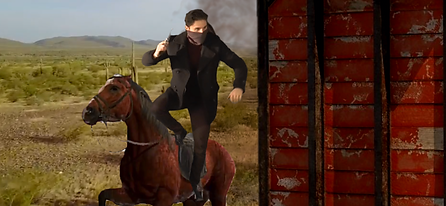
Two things annoy me about this shot: first is the fact that I'm not actually holding onto any reins but I'm whipping my arm as though I am, but I've covered that already. The second is that the lighting I used in the green-screen studio is far too harsh. As great as the lighting looks on the scarf and in my hair, my face is almost entirely washed out, and it's a frustrating exercise in failure to try and match an over-exposed white like that to the light and dark balance of a darker background, and to the warmer colour scheme.
Regardless, the rest of the shot turned out well. Honestly I wish there was a little more texture on the CGI horse model I used, but it was the most detailed one I could find with a saddle.
I feel I should have found a way to keep the train to the left of the character present. The train is behind the camera's perspective in this shot, so it needn't be included, but I'd have preferred if it had been, perhaps if just with some out of focus train cars encroaching on either side of the frame. Still, there's no harm done, and for what the shot is I feel it turned out fine. I got to use an obscenely bright lens flare, and anybody familiar with any of my work knows I'm always happy where a lens flare is involved. It's the same one I used in a couple of shots from the War, and while it is an external image that has to be added on a glow layer rather than being one of Premier Pro's built-in lens flares, making it a little harder to add and sync with the video, I'm very fond of it. I actually feel that, despite its brightness and warmth, it's a little less intrusive than Premier's options, as it doesn't flare across the entire screen and have orbs that move around with the changing perspective of the camera, but rather takes up as much width as I see fit, as its size is alterable.
Something else that's just occurred to me is that neither the scarf nor my hair is being influenced by the wind. Moving at the speed of a train, part of the illusion depends on wind resistance affecting my wardrobe, which is something I'll have to take into account should I move forward with All Abhorred and need to put actors onto horses again, likely just with a big fan.
Now for my favourite shot in the piece. When I came up with this, and while I was shooting it, I had no idea if it would actually work and look at all convincing. But, while it definitely didn't turn out to be the most photorealistic green-screen work the world has ever seen, it went surprisingly well.
In All Abhorred, several characters will be required to jump out of the moving train and onto a moving horse. In this VFX test, however, I had arranged that process in reverse, leaving me with a shot in which my character needs to stand up on the back of his moving steed and leap into the open door of a carriage.
First I had to figure out how that manoeuvre would be achieved and then perform it on the green-screen. The two problems I encountered in doing so were that the green sheet over the stool was very breezy, and so it kept getting in the way of leg and I ended up with a portion of my foot missing. Fortunately that foot isn't visible in the aspect ratio of the final footage, so it didn't matter in the end. The other problem was that I am significantly heavier than the stool and had to jump off it at an angle, which resulted with the stool rocking in the other direction and almost slipping out from under me as I attempted the stunt. Fortunately I landed it, and the footage turned out fine.
Again, I had to sync the position of the footage of myself with the turbulence of the stirrups on the saddle of the horse, to maintain the illusion that I was standing on the back of the horse itself. I feel that it should have been a little bumpier than I ended up making it, but there's a fine line to avoid crossing wherein the footage of myself would begin to be too bumpy and it would be disillusioning that none of my clothing or hair was jostling along.
Once I was on the back of the horse, the horse had to be in the desert. Once again, this was a simple matter of finding the right stock footage, which isn't too difficult, as there are few obstacles to ruin the shot when your piece is set in a location literally names for being empty.
I then had to add the train car into which my character would jump. Once that had been imposed and colour-corrected a little, I nested it with some shaky handheld footage and used the warp stabiliser tool to add a shake effect to just the carriage. This made it look as though it were jostling and wobbling, like a train on a track. From there, it was a simple matter of framing the shot right so that it actually looked good, and so that it wasn't obvious that there was no carriage in front of the one into which I jumped. I also added a plume of dust rising from behind my horse; the desert sand that the horse kicks up as it runs. I added another lens flare, colour corrected the piece as a whole, and was left with my favourite shot in the piece.
Preliminary VFX Test
Unlike the Pianist That Shouldn't've and Burial Ground, All Abhorred has the benefit of mostly taking place in one set. However, the finale of the film would feature a sequence in which the side door of the train car is opened and a posse of bandits ride alongside the train and extract some of the prisoners. This sequence would require significant VFX, so it's necessary to experiment with a small scene of a similar nature to ensure that I would be able to achieve the effects.


More than anything it's essential to the premise of All Abhorred that I be able to put an actor on a horse. This isn't an alien concept to me as I had put my classmate at the time, Stephen, on a horse for my adaptation of Alfred Noyes' the Highwayman last year, but I wasn't entirely happy with the VFX in the Highwayman, and the entirety of that film takes place at night. This sequence, however, and the pertinent scene in All Abhorred, would take place during daytime or sunset, and out in the open desert, which means that most, if not all, of the actor and horse will be visible at least briefly.
I began the same way as I did for the Highwayman; by putting an actor, myself in this case, on a stool with a green sheet over it in front of a green-screen. I actually made a mistake this time that I didn't make last year, in that I failed to cover up the farthest leg with the green sheet, meaning that when I imposed the footage of myself over the horse both legs were visible, despite the reality being that the farthest leg would be out of sight behind the horse's torso.
In all honesty, I didn't have the patience to go through frame-by-frame masking out the leg. It's only a test, after all, and the purpose of a test is to learn what mistakes to avoid and how to improve, so I settled for what I had and continued.
Unlike with the Highwayman, I did take an extra step in the process this time, which was to go through adding position keyframes to the footage of myself to sink my motion with that of the horse so that I bounced up and down with the rhythm of the horse's steps. It's not perfect, as the timing wasn't synced flawlessly in performance while I shot it, but the look isn't entirely unconvincing. I think the only major part of it that ended up annoyingly noticeable in the final footage is that I'm not actually holding onto any reins, so my fist is just waving limply in the air beside the horse's neck.
Next was simply to take stock footage of a train and impose myself on my horse over at and animate my position to appear as though my horse is galloping alongside the carriages. If All Abhorred goes forward I'll choose footage of a train more realistic to the time period, but I liked this shot of the train I found, so I opted to just impose a smoke trail over top of that rather than scour for free footage of an 1800's steam locomotive, as would be appropriate in the setting.
The final touches, as usual, were simply colour grading, atmospheric dust, and grain. I'm actually not as happy as could be with the results of the colour grading in this piece, but I'll do into that in more detail later.



This last shot was the simplest of them all, probably because I didn't have to put anybody on the back of a horse.
First things first, a simple matter of imposing myself into an old railway car. The image of a train interior that I liked the most had lots of windows, which was great, but meant that I had to cut them all out. It also had a closed door, as tends to be protocol in a moving train in real life, so I had to cut that out too. Once I was in it and I had tweaked the colours a bit, as the original image was very cool in tone, I nested the two and added a lot of shakiness, to give the illusion of the train car jostling and moving on the journey. Then I added the footage of the desert in the background, as well as some environmental sand and dust, and added another shaky camera effect to the whole thing.
Once that was all composed I just had to do the colour grading, which I still feel was a little inconsistent as the lighting washed out my face a lot, but look pretty good. I also added the horse in the background for a moment, slowing down and being left out of sight of the train after my character jumps off.
Despite it being just a VFX test reel, I added a soundtrack and sound effects, just because I was happy with the piece and wanted it to standalone as a short clip. I used the rather fitting the Railroad Waits for No One from Hans Zimmer's OST for the Lone Ranger, and some simple stock sounds of a steam engine, a galloping horse, and a gun being cocked.
I'm pretty happy with it overall, especially seeing as it as only a short test of the CGI that would go into making the finale scene of All Abhorred. Even despite this being the nature of it, I feel it stands alone pretty well, and considering I edited the whole thing in just one afternoon I think it's a real testament to what could potentially be achieved in a little more time with a little more care and attention to detail.
Below is the composed VFX test for All Abhorred.