UNIT XI.
The most interesting development I've gone through over the duration of not only this course but my previous year too, is how my intentions for my place in the film industry have shifted.
Prior to enrolling in the art and design course at MidKent I always wanted to be an actor and, to me, writing was simply a means by which I could potentially achieve it through self-casting. As my interest in art and the development of my own style blossomed I began to take more of an interest in directing by the time I joined the media filmmaking course. After two years of the course I'm certain that writing and directing is the best avenue for me to follow.
Strengths & Weaknesses.
I think that my biggest strength is the ability to overcome obstacles, and that particular ability has the benefit of lending itself to every other strength and weakness I have, and making the strengths easier to improve and the weaknesses easier to avert. After all of the obstructions that threatened production during my FMP, the result that I was able to achieve is a testament to this specific strength, and I'm very proud of how hard I pushed myself to be able to produce a complete re-write of a new concept in the space of a week.
I'm capable enough in the fields that are important to me that the only real weaknesses are my simple lack of experience. I'm a strong director, writer, and cinematographer, and a capable editor. My real weaknesses lie in sound design and in some aspects of the pre-production formalities.
Funnily enough, when I asked my peers to identify things that they considered my strengths and weaknesses, they identified weaknesses that I consider to be strengths. Their most common criticism of me is that I'm too much of a perfectionist, which I've always found to be strange. The idea that wanting something to be perfect is a standard too high and is doomed to fail has never quite made sense to me. I've always felt that even if I do fail in achieving perfection, which is admittedly more often than not inevitable, I'm always bound to have a better result simply as an effect of trying.
I do think there's also something to be said for the fact that my peers likely gave me an easy break, and that it would be difficult for me to find harsh criticisms of my work among them. Regardless, I know where I need to improve, and perfectionism is no such area.
I think one of my biggest weaknesses is the way that I work as part of a team. I'm a perfectly capable team player, but I often find myself trying to assume leadership of said team. I work well with others, but also work well leading them, and so I've occasionally found myself giving orders to people on the set of other students' productions, and having to consciously back down and mind my place.
Work Experience.
During my time on the course I completed work experience working as a camera operator and assistant for Chris K. Newberry on an advertising shoot for the college on behalf of Newberry's company, Wildwood Media.
Over the course of the shoot I was able to learn and experiment with new equipment that I hadn't previously had an opportunity to use, including a motorised gimbal and a more advanced camera. Working with Chris was an opportunity to familiarise myself with the camera, with the equipment, and with working as part of a team and directing extras, but it was a also a very useful, and in some cases difficult, experience to have to work around a pre-existing set over which I had no control, and to try and make use of the resources and lighting in a way that would come across well on camera while having no influence over it. It was good to have a distinctly different way to experiment with cinematography and shot composition, as this afforded, and it was also a beneficial insight into the nature of recording promotional pieces and how they differ from other, more personally influenced productions.
Ambitions.
In the long term my ambition is to make movies. To get up every day ridiculously early and step out onto a set that looks as if it jumped straight out of my own imagination is where I want to be. But I've had to take a step back and ask myself if that vision belongs at the end of a five-year plan, or even a ten-year plan. One of the question I've found myself having to confront is, no matter how much I want it, am I ready? And I don't think so. I don't have the expertise, the experience, or - plainly put - the maturity as an artist to be helming productions for the world to see.
I'm not much of a fan of making linear plans for things, especially one that takes place over the course of five years. Five years ago, as of the time this was written, I was fourteen, and if someone had asked me to write up a five year plan I don't think one single detail of it would be comparable to how the last five years of my life came to be. In five years' time I'll be twenty-four, and thinking about how much my position is going to change between then and now makes me near positive that most, if not all, of any five-year plan I write now will not come to be.
2019-2020
Within the next year - or preferably the next few months - I'd like to be relatively secure in a low-level, probably entry-tier, job in the film industry. I don't really have any specifics in mind, for example whether it's a low or high budget production, whether it's TV, film, maybe even YouTube, it doesn't matter, I just need to be secured into that gateway position. Because that, not now, is where the real opportunities begin. From what I've read it sounds much easier to pivot from position to position within the industry than it is to get into it in the first place.
In my free time during this period, assuming I have any, I'd like to be working on my writing. A route I know would be good to follow would be producing my own short films on the limited budget of my own income, but honestly this doesn't particularly interest me. Not because I'm not interested in making short films, but because I just don't see my own vision that way. I haven't had ideas that I want to make on that scale. Not because they wouldn't work, but because I find myself wanting to save every idea I have until it can be brought to life in the best way possible. Is that, perhaps, and example of the perfectionism that my peers criticised me for? Definitely, but nevertheless it's how I feel. I'd be happier doing low-level work on someone else's vision than doing high-level work on the most rudimentary version of my own. And, as I said, I just don't feel ready to take the helm yet. I don't feel that my writing is ready, and I don't have the experience with any equipment other than the college's.
2020-2021
I anticipate being in relatively the same position and situation at this point. If possible I'd surely be making efforts to climb the ladder and take on more responsibilities within whatever company I work, and perhaps - if I feel that my skills have advanced enough at this point - putting out my writing and pitching my ideas, either to my place of employment or to other relevant studios.
At this time saving money will be a big part of determining what to pursue in the future. With enough money saved I could go down several routed, but their are two that interest me the most. The first is to use the money as a budget for something, and to actually pursue creating something of my own. Again, however, this depends on whether I feel my ability has matured enough. The other route is to move abroad, to either the U.S. or Canada, and start feeling out the industry there. It was always my dream ever since I first took an interest in film to make it to the bigger U.S. studios. This route is, somewhat surprisingly, much more feasible than the other, as it doesn't require equipment or other people, and there isn't the ambiguity of whether or not I consider myself ready, as there is with the short film. However this idea is much more of a risk, as failure in this particular endeavour, unlike the other, leaves me in a totally new and potentially precarious situation.
It's things like this that really contribute to my aversion of the 'five-year-plan'. How do I account for two different possibilities, both of which are so fickle in their potentialities?
2021-2022
This would be the point wherein the previously raised questions become concerns. By this time, whether it be late '21 or early '22, I should (assuming the previous steps went to plan) have decent means. Which makes this the point that I would need to decide, or at least begin to, what should be done. As stated, the concern isn't the opportunities presented by either plan. They're both about equal in that regard. Having, according to the plan, been employed in the industry for a couple years now, I should be able to pursue the State-side plan with some degree of confidence in success, as I should have decent experience and desirability under my belt. On the other hand, said experience would also contribute to getting a good result out of pursuing the short-film plan, and a successful high-quality short can provide a lot of opportunities of its own via festivals and networking, and acting as a sort of high-profile portfolio.
With all that being said, the concern is still, as stated, that the stakes are much higher if I choose to purse the plan of looking for work abroad, however that is the plan that I favour. I suppose that says something about the fact that it's all a bit romanticised in my head. That I seem to prefer the idea of taking steps that align more with trying to piece together my eventual dream bit-by-bit, rather than taking more practical steps with more safety nets, taking fewer risks.
2022-2023
Late 2022 would likely encompass the aforementioned transitionary period, whatever I decide that to be. Now, I can't predict what action I'll have to take if whatever endeavour I undertake somehow crashes and burns, as it's too unpredictable, so assuming everything went successfully, whether that be a short film or a transition abroad, it should be smooth sailing from there. I'll either be employed in a more high-profile place in a more successful are of the industry, or I'll be in the same place but have something terrific to show for it, which should allow me to smoothly pivot into a higher level therein.
Again, all of this is very exemplary of why I loathe planning of this sort. I mean, hasn't the person who wrote this into the criteria seen Jane the Virgin? I'm not saying that my five-year-plan would get thrown off because I could get artificially inseminated, because I probably won't, but I am saying that the deeper you get into the five-year-plan, the more potential outcomes each action could have, and the more potential opportunities that could come your way, and those kinds of things are too nuanced to predict.
Regardless, hopefully by the end of 2023 I'll be in steady, lucrative employment - and I mean that in terms of personal fulfilment, not financial gain - at a decent place in the industry, hopefully higher than where I started. And hopefully, wherever I may be, I'll be able to, by this point, have something tangible to show for it.
2023-2024
To assume that I'll be in some significantly different place by the end of this next year is to be ignorant of how jobs work. I'll likely be very happy in whatever position I hold. Looking to move up further, certainly, but it's not like there's just a new promotion every year. As fanciful as it is to say that I'll be helming a blockbuster by the time I'm twenty-four, I just don't see it happening, unless some other part of my five year plan takes a hard left and I get catapulted into a bigger, better opportunity by some unforeseen stroke of fortune.
I'll likely just be spending whatever presumably bombastic income I'll be getting on more short films, or working on my writing and sending that out to newly available, higher-level recipients.
I don't see there being any particular obstacles to this plan coming to fruition, though that could come largely from the fact that the whole plan presumes to 'play it safe', so to speak. As of right now I'm actually having considerable difficulty finding a placement in the industry due to my lack of experience, and the fact that I don't have my diploma yet. Experience seems to be preferred by employers over qualification, but that doesn't matter a whole lot so long as I don't technically have either one.
I definitely see my confidence, perfectionism, and my ability as a director being the biggest contributors to my employability at the moment, as opposed to detriments, which their categorisation as 'weaknesses' by my fellows might suggest, as the first two help in job interviews and the latter contributed to the footage in my showreel, which I think is going to be the stand-out factor that determines where I find employment, and at what level.
I also think, especially if I employ my skills to creating as short film, or multiple, during my employment that my ability will help me to climb the hierarchy within my field, as a short film will be very clearly demonstrative of my capabilities, and of the improvements that I'll hopefully have made during my tenure.
Reaching the goal.
What's important when considering avenues to reaching my future goals is that my aspirations aren't included in the five-year-plan. As stated, I feel that a five-year-plan is far too short term to encompass the destination to which I'd like my career to lead, or indeed to include any significant changes in situation at all. There is, of course, the possibility that a piece of my writing gets picked up by a studio, or that a studio or executive at a festival is particularly taken with my short film, should I pursue that route, in which case the direction of my career would gain a significant acceleration. The thing is that such an occurrence is simply not possible to plan for because, unlike the other relatively procedural pursuits, such as making the short itself and being at the lower tiers of the employment ladder in the industry, the possibility of being singled-out in such a manner is purely up to chance for several reasons. One is that it's largely subjective whether or not any particular person or persons are interested in my writing or hypothetical short, and another is that said writing or short hasn't been created yet, or is at least in a very rudimentary form, as nothing on which I'm currently working is ready to be publicised yet.
Regardless, the point is that planning for reaching my eventual goal - being a high-budget writer director, hopefully in the Hollywood sphere - isn't as linear or strictly foreseeable as the five-year-plan, which was itself not particularly chronologically predictable anyway.
To examine different avenues I might take to reach my goal, I felt that the best method would be to look at real-life examples. I've selected some of the most successful among my favourite high-profile directors to see the different ways in which they reached their status.

Christopher Nolan.
While certainly high on the list, Nolan isn't my favourite director, however he is the director of my favourite movie: Inception. I find Nolan's career admirable not in its spectacle, acclaim, or grandeur, but rather in its principles. Nolan is famous for working in a significantly different direction than the rest of Hollywood tends to, refusing to use second units for action, keeping VFX shots to the minimum possible, and creating a calm, intimate atmosphere on set.
Nolan had been making short films since the age of seven, filming stop-motion with his childhood action figures. Nolan began working on films with Adrien and Roko Belic in 1989, though information is spotty on exactly how they came to meet, which isn't very helpful. In '98 Nolan and some friends self-funded a feature film, directed by Nolan, called Following, with only $3,000. The film received remarkable acclaim and notoriety during its festival run, giving Nolan the opportunity and connections to pitch his version of the concept for the film that would become Memento. From there it's the usual linear progression; a publicly seen, critically acclaimed movie attracts attention, and that attention attracts contracts.
While I don't have any successful documentarian friends I could collaborate with, that doesn't appear to have been the part of Nolan's early career that caused it to take off. In fact, it seems to have played little part whatsoever, with the real catalyst instead being his short film. Considering that making a short film for a festival is something I previously stated I didn't have a lot of confidence in, and considering that it's something of a pattern among successful directors, I think I might need to reevaluate my stance.
Zack Snyder.
Here it is. The controversial statement that gets me into a lot of heated discussions when brought up among fellow film enthusiasts: Zack Snyder is my favourite director. He's been presented in media as a 'love him or hate him' type, but I don't find that to be a particularly realistic or intelligent viewpoint to hold about anything, not just this. Regardless, I do love his work, and beyond simply really enjoying his particular style, both in storytelling and visuals, I also enjoy the uncompromising nature of it. Studios have changed his work to fit to public demand, but he doesn't, and I admire that, which I suppose is easy seeing as I'm not one of the people demanding the changes, but it is what it is.
I've had trouble finding information on what specifically Snyder's first career step was. I know that he wasn't trained as a filmmaker, studying art and painting, but also that he had stepped into film right after high school. I assume from this that he either followed the short-film route himself, or that he had gotten an entry-level job somewhere, but I couldn't find the record. The earliest example of his work I could find was a short documentary about Michael Jordan called Playground, on which he's credited as a director but the short appears to be comprised of archive-type footage. After that he began directing music videos, mostly for rock bands. Again, there's little information about how exactly that came to pass, which is unhelpful.
From his work on music videos, Snyder was drafted to direct the 2004 reboot of Dawn of the Dead, written by James Gunn. The following year, when producer Gianni Nunnari was eyeing the rights to adapt Frank Miller's 300 graphic novel into a film, hw brought Snyder in to direct after finding out that he had tried to get an adaptation of his own greenlit years prior. From there it's the usual again; talent gets recognised and gets more and more features. I think the different here with Nolan's is that Nolan seemed to steadily climb in notoriety, with each feature being more publicised than the last, while Snyder went from doing music videos and car commercials to immediately doing spotlighted Hollywood feature films.


Spike Lee.
Well, here we go again. Another director who got his start by making an indie feature and getting noticed during its festival run. Lee's transition wasn't quite as smooth as Nolan's, but only narrowly. After his independent film Joe's Bed-Stuy Barbershop: We Cut Heads, he moved onto She's Gotta Have It, which had a significantly bigger budget, as it was funded and distributed, but it was still relatively small-scale. Not in success however, as it grossed over $7,000,000 at the U.S. box-office, 40x its budget. From then on his career was hit after hit, with his next film, his third feature; Do The Right Thing getting an Oscar nomination for best original screenplay. Lee would continue to be nominated for (and, in my opinion, snubbed for) numerous Oscars over his career, until eventually winning Best Adapted Screenplay in 2019 for BlacKkKlansman.
Lee is another example of a filmmaker who I value not just for his phenomenal ability in direction and writing, but also his phenomenal dedication to it, and to telling his story with no compromise, no matter how harsh the subject matter. It helps that Lee always tends to be on the right side of the subject matter, and that the only people who tend to be made uncomfortable by his narrative choices aren't particularly likeable people.
Again, I'm finding that all of the influential directors I'm looking at as guidance down my career path all seemed to get there by biting the bullet and making their movie. I'm all but convinced at this point that the self-financed, relatively short feature film for festivals is the most surefire way to go, which makes it the road that I ought to take. In other words, I need to do the right thing.
James Cameron.
This is an interesting one, because it's the one that's more akin to what I had envisioned for myself, and yet somehow still radically out of what I considered. James Cameron did write and direct a short, called Xenogenesis, in 1978, but it was significantly shorter than that of the previous studies, at just 10 minutes long. After that he began working as a production assistant on Rock and Roll High School the following year, which is more like what I'd envisioned myself doing. However, from there he moved in a different direction, becoming a designer and maker of miniatures at Roger Corman Studios, and then moving on to art and special-effects direction. He was brought on as the FX director for Piranha II, and when the original director dropped out of the project Cameron was given the helm.
Following that, Cameron wrote the Terminator, and managed to sell the script to a friend who had started her own production company. This is a very specific and personal stroke of fortune, and one that I may not be afforded, which is the type of thing that makes planning for this so complicated, as I mention in my original five-year-plan. After that, Cameron was able to direct the Terminator, and all of his following films, becoming an enduring legend in the industry, having directed two of the three highest grossing movies of all time as of June 2019, and two of the most critically acclaimed action movies of all time in the form of the first two installations in the Terminator franchise.

So, while it's clear that there isn't one simple path to take, it's even more clear that there is a best path to take, and that appears to be putting in the money, no matter how little, and effort, no matter how short the shoot, of writing and directing an independent film and battling it out at film festivals.
In a way, further exploration of my potential career paths has made my five-year-plan potentially obsolete, as I've taken a pretty hard right turn from the opinion that I wasn't ready to make an indie film and that it would be a risk, into the belief that it's almost positively the most reliable way to get my name into the industry and my talents recognised.
The Other Option.
I have, however, already had a look into finding entry-level jobs in the industry, but I keep bumping up against one obstacle: a preposterous amount of the jobs advertised as 'entry level' are a bit more complicated.
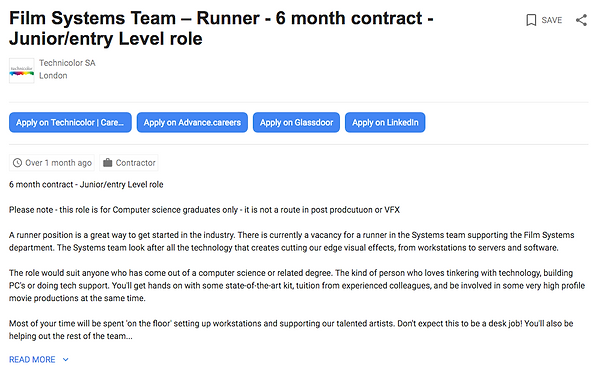
For example, the job advertisement above exhibits a characteristic that many similar opportunities in the online job market present, which is that it lists itself as entry-level in its header only to reveal in its body that not only does it require a specific qualification, but it is also geared more to a slightly different are in the field. Beyond the 'read more' section there also happens to be a specification that prior experience is required.
Now, there's nothing wrong with leaving these details out of the heading, in fact its probably for the best, as otherwise the heading is too messy. And this is actually an entry-level job, as stated. It could be argued that the call for experience means this isn't entry-level, but experience doesn't necessarily mean paid work. The problem isn't that is misleading, because it mostly isn't, but rather than the water is largely muddied with these ambiguous applications that turn out to have other rigid requirements. I think there's a conception that things like this, or others that don't require a degree but do require experience are deceptive, and that they aren't really entry-level, but personally I don't think that's the problem. I think the problem is that these are muddled in with the others, not making it impossible to find a relevant opportunity, but making it a lot harder. It's really just a matter of perseverance.

Now this is entry-level. Found on another job-seeking site, I had to weed through several dozen other posts with almost identical headers until I found this, one that doesn't require experience, just ability, which I just so happen to have in spades, to go along with my abundance of humility. From this point it's just a matter of crafting a CV.
I have also tried to reach out to a friend of a friend of a friend who works in film booking shooting locations, and actually worked on high-profile features including 007's Spectre and DC's Wonder Woman, but it's been over a month and I'm yet to receive a response there. Assuming he's not simply too busy, it's likely that their was some problem with the formality of the Email I sent, or that it presented me more as someone looking to get into film rather than showcasing that I'm already someone with the necessary ability.
CV.
My problem at the moment is that if I wanted to get a job working in food or retail I could fill a CV to the brim and have a job the next day, as that's where my employment experience is. When I try to cater a CV more to being desirable for consideration in film industry jobs it's a little less dense, which is a problem seeing as experience tends to be of greater value to employers in the industry than qualification or experience in other fields, although qualification is usually sought out additionally, and I don't technically have that yet either.
That's the CV that I've been working with, and it hasn't gotten me a lot of luck.
I think the thing that bothers me the most isn't so much the CV itself, but rather the fact that the CV is that onto which my value is projected. I have a lot more confidence in my showreel as an exhibition of my abilities, at least visually (until I finish cleaning up a version that features dialogue), but it's rarely, if ever, the first thing that employers examine, so if the CV isn't good enough to convince them into watching the showreel then that particular bit of leverage is dead in the water.
Here's my card.
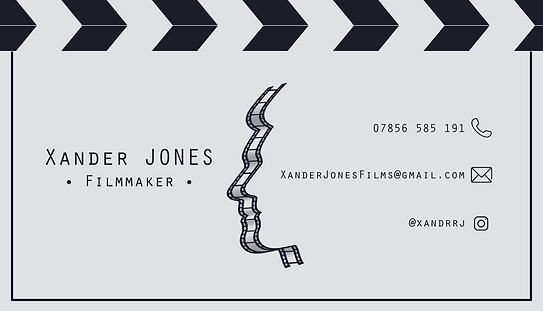
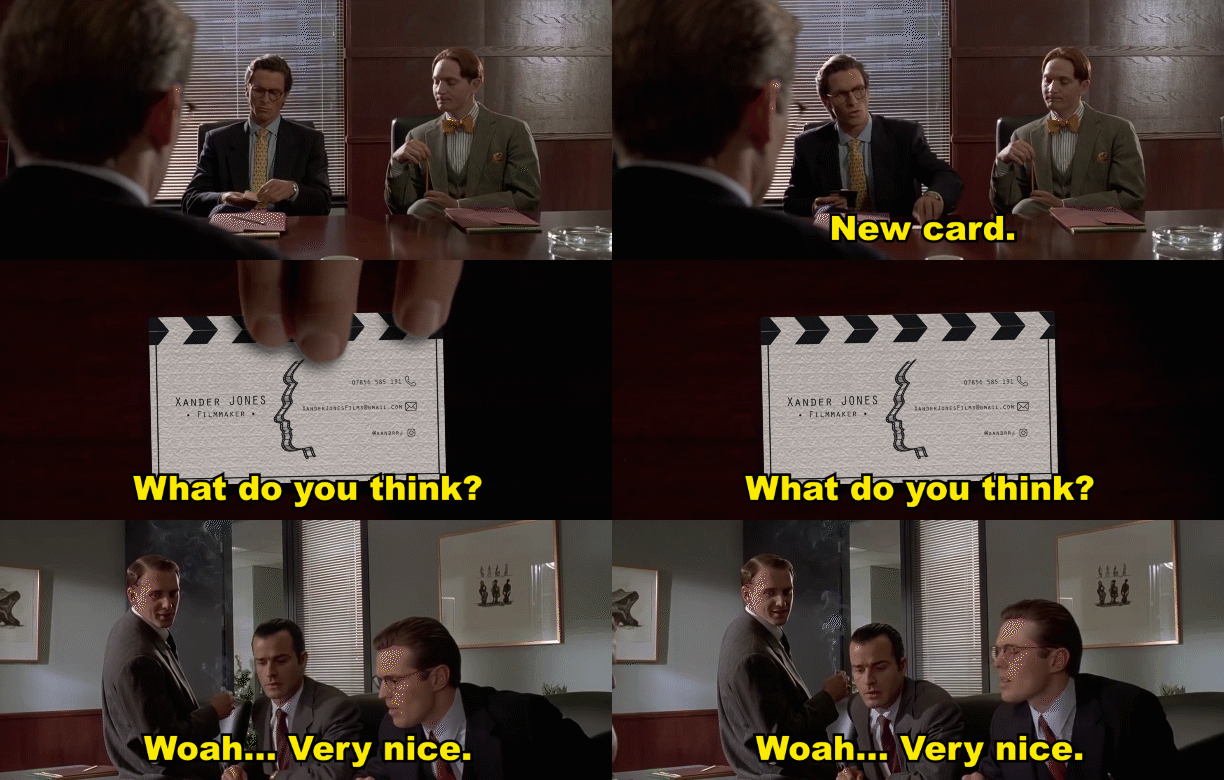
Designing a business card is just a bit of fun. It's probably obvious to anyone who knows me and the way that I work that I'm a very visual and hands-on person, so any opportunity to play around with design work like this is a welcome endeavour.
I'm obviously very proud of my logo, which I use for just about everything I do in film, not least because I made it myself. It's my own side profile outlined by 35mm film. That, combined with the idea to try and make the card resemble a clapperboard using the chevrons along the top border makes for a satisfyingly minimal yet recognisably relevant business card. Assuming I ever get around to printing any there would obviously need to be a couple of changes first. I think the way that the text is laid out is a little inconsistent and could use some work, just in terms of formatting, and I'd like to include a website on the card once I actually get a nice domain name. I probably ought to get around to changing my Instagram to be a little more professional too, either that or create a new account to use only for film-related content. Regardless, I'm happy with the design for now and I only see it getting better.