
UNIT X.
What is a magazine show?
In essence a magazine show is a genre of TV similar to a talk show, but with a recurring cast of presenters, usually discussing varied but currently relevant news stories rather than personal anecdotes. Examples include shows like 60 Minutes or 20/20.
This Morning vs. the One Show.
Something that I noticed almost immediately when examining magazine shows is that there is no consistent degree of formality. One magazine show may be very informal, with hosts gossiping and maintaining a light-hearted tone throughout, whereas others may present themselves more sincerely, and focus more on the matter at hand rather than their own interactions. Interestingly, a lot of this seems to be due to a cultural divide, as I noticed that UK-based magazine shows tend to follow the former method, and shows produced in the USA tend to follow the latter. There are some exceptions, but as a whole it seems that American magazine show hosts behave more professionally, almost like news anchors, while British hosts are much more informal and personal when speaking to guest.
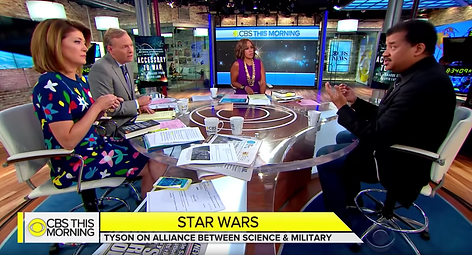

I think a lot of this may be due to the setting of the respective magazine show. As seen in the images pictures left, the US-based show, CBS' This Morning, features several hosts in an ornate set, seated around a table littered with notes and documents. Opposite the hosts sits their guest, Neil DeGrasse Tyson, who speaks with them about the political impact and reality of space exploration, and how it relates to his recently published book.
The setting of BBC's the One Show is starkly different. It's a much more casual environment, with presenters and their guest sat on couches around a small coffee table. The lighting and backdrop is bright and colourful, and the conversation between the guest and the hosts is much more personable and informed by feelings.
This difference in tone is also reflected in the subject matter tackled by the two shows. This Morning tackles more mature and political themes, discussing the US military with Tyson, and featuring Michael Phelps to talk about humanitarian aid and mental illness. Conversely, the hosts of the One Show discuss family and kids with their guest, Jamie Oliver, and laugh at backlash to his cookbook. It seems as though the difference is that This Morning uses more political commentary, and features professional guests who are pertinent, whereas the One Show features guests to discuss their personal lives.
Knowing this, the divide between the target demographics of the two shows is between those who wish to be informed about current events, and those who wish to learn about celebrities.
Another difference I noticed is that This Morning features straplines, the tiles at the base of the frame that feature a headline, or name a speaker, whereas the One Show doesn't. This is in line with the intentions of the show, even if it's a very small feature, as it's another example of This Morning's intention to be informative and professional, while the One Show is presented more casually.
The camera angles are also of note. In the shot of This Morning I used above, Tyson is pictured from his left side, facing to the left of the frame. In this medium close-up, Tyson is pictured subtly from his right, facing the right side of the shot. This Morning's set is colossal in comparison of that of the One Show, and this change in camera angle - and indeed the many angles featured for the close-ups of every host - is because This Morning use multiple cameras all dispersed throughout their set, so as to get a diverse range of angles, and to be able to focus on an individual speaker. From what I can tell, This Morning features at least seven cameras, spaced all around the set.
The One Show, on the other hand, has its only two hosts sat beside one another, and only features three camera angles; one directed at the host, one directed at the guest, and one long shot of the set.


As a whole it seems like there's a decision to be made when producing a magazine show, which is whether you want to present yourself like a regular news show that occasionally features different content, or whether you want to maintain a completely casual environment.
We've been tasked with catering our magazine show to an audience aged 15-19, which means deciding on which of the two formats would be best suited to that demographic. It's a difficult decision, because generalisations would imply that the latter; the informal formula, would be best suited to teenagers, but in reality people's interests are much more varied and subjective than that.
I'm personally much more interested in following the more formal and professional technique, so suiting it to the teenaged demographic is going to mostly rely on the news story or stories I'll be featuring.
Beyond their in-studio presenters, magazine shows feature an extra host or two in the form of field reporters.
While I dislike the fact that magazine show presenters will offer their own opinion on a serious news story, I do like that they send a host into the field to get the opinions of witnesses and parties involved in the incident or incidents in question.
Once again, This Morning features a strapline naming their field correspondent, as well as straplines naming everybody they interview, whereas the One Show relies on verbal introductions. The One Show's field correspondent was energetic and loud, putting on a performance for the camera and sensationalising everything about which he spoke. I presume that this is endearing to a regular viewer, but not knowing the presenter myself, and being against biased reporting, I was put off by his devil-may-care attitude and the fact that he asked a concerning amount of pointed, leading questions to all of his interviewees.
This Morning did much better, asking open and genuine questions, and remaining professional and inquisitive, letting the interviewee speak, rather than speaking over them to ask a new leading question, as the One Show did.
I will acknowledge that the two shows were covering different topics, and the One
Show's was not as serious as This
Morning's. There's nothing wrong with
levity, but the problem lies in that
the One Show's correspondent's excess
of personality overpowered the people
whom he interviewed to the point where
their input was redundant and only his
opinion was being highlighted.
Magazine shows such as This
Morning and 60 Minutes sometimes
feature one-on-one interviews with relevant political figures. These interviews are set and shot very differently to to the celebrity and public figure interviews held on the main set, as they tend to take a more sincere tone.
These interviews aren't opinion-based, but are potentially subject to bias, as most, if not all, of the information featured comes straight from the mouth of the political figure in question.


The set of This Morning isn't as divided up at the set of the One Show. While the One Show is a large open space with a few other settings positioned behind the main camera with focus being drawn to them only when necessary, every aspect of the set of This Morning is entirely visible from the main camera, especially when wide introductory shots are used.
With the table around which the presenters and guests sit in the centre of the set, the background is divided into several sections made up of monitors and shelves which are adorned with props or images pertinent to the topics of the broadcast and are different in every segment.
There is also a desk visible in the background, to the left of the frame in wide shots, at which a small group is working, who
I presume are journalists, or are operating
the screens. It's an interesting choice to
feature crew members so prominently in a
live broadcast, especially since the camera
occasionally cuts to a closer shot of them,
but it adds an element of professionalism
to broadcast. However, I have a feeling that
showing crew members doing research live in
the background could actually be a ploy to try and feign greater credibility which, while slightly deceptive, is admittedly clever and does work to some effect.
The set of the One Show appears much larger, but I don't think it is, it appears to simply be much less detailed. Unlike This Morning, the set of the One Show isn't entirely visible in the wide shots. In the majority of the wide shots of the One Show's set, the large monitor seen in the image to the right isn't visible, as the shot focuses on framing the couch. The much longer shot that shows the large monitor is only featured when there is some content on he monitor, which contrasts This Morning, whose own large monitor is directly behind the presenters and guest(s), and as such is always visible in the wides.
The One Show occasionally cuts away to a small setting that is almost directly behind the main camera, which is simply a few vertical monitors. A visitor or group of visitors related to the celebrity guest are usually the people featured in these shots, and they usually have little to no interaction or dialogue with the presenters. This Morning does have a second large monitor, just barely visible on the very far right of their wide shots, to which they occasionally cut away, but this is used by presenters to introduce on-location segments.


From what I can tell, the One Show seems to have their cameras set up in the middle of their set facing outwards in multiple directions. The couch on which the guests sit is against the opposite wall to where the vertical screens are, and when the presenters gesture to the vertical screens they look somewhere behind the main camera. This Morning, on the other hand, looks to have a crescent-shaped setup of cameras against that face into the set. All of the set-pieces are against walls arranged in a right-angle and, while there are multiple angles featured of presenters and guests, the set is always seen from the same rough direction.
I can't tell for sure but, at an educated guess, below is what the setups of the sets appear to be.

More or less striking a middle ground between the two is the UK version of This Morning, featuring Phillip Schofield and Holly Willoughby, two of the most recognisable names in the genre.
However, while the set of This Morning with Phillip & Holly finds itself in an aesthetic between CBS This Morning and the One Show, the content find itself on no such ground. If magazine shows are analogous to printed magazines and newspapers, This Morning with Phillip & Holly leans about as closely to the more tabloid-style content as it possibly can.
Pictured right is an assortment of This Morning with Phillip & Holly's choice extracts published on their YouTube channel. Seeing as YouTube channels serve as promotion, the segments chosen serve as examples of how the show would like to be represented and the interests of the audience to whom they wish to appeal.
This makes it clear that, while This Morning with Phillip & Holly broadcasts to and shapes itself around an adult audience, they still focus more on gossip and trivial headlines rather than mature or intellectual talk-pieces or hot-button issues.


Target audience.
For our magazine show we need to engage with a target audience between the ages of 15 and 19. This group falls into the 'E demographic' of unskilled and unemployed persons and students, but they also fill their own niche separate from unemployed adults and pensioners. Issues relevant to adults might not be relevant to late-teens, and vice versa, so targeting a magazine show at this audience will need to be much more specific than a production simply encompassing all unemployed and unskilled workers.
With that being said, the ages of 15-19 represent a transitionary period into adulthood that makes the interests and concerns of the demographic a lot broader than one would expect a four-year span to have. 15 year-olds and many 16 year-olds are still in secondary school, and likely have very little political interest, being more focused on their GCSE's. For the rest of the group, that worry is behind them and now they're faced with new challenges to which a 15 or 16 year-old can't relate. At 17 one can begin learning to drive, which opens up many of the demographic to concerns about road safety and construction. At 18 one can register to vote, which means that the 18 and 19 year olds, especially in the current climate, suddenly have a lot of weight on their shoulders if they choose to be politically active, which carries with it a lot of political and moral concerns. At 19 a person might have already concluded their education and be moving into a working field, and it's possible, if uncommon, that they could have already ascended into the C2 or C1 demographic group of skilled manual workers or lower-management roles.

With so much diversity in the concerns and interests of such a small group, it could actually prove easier to narrow down some hot-button issues that the majority of 15-19 year olds care about, as the amount of common interest in the group should be relatively little.
When it comes to the differences between the One Show and This Morning that I pointed out previously, I think there's a middle ground that needs to be used to cater to this demographic. I think that much of the 15-19 demographic, especially the younger end, wouldn't have as much interest in the more serious and refined tone of This Morning's in-studio scenes as they might not be engaged in large-scale political and philosophical debates. Personally, that's the kind of content I'd much rather tackle, but beyond the fact that the 15-19 demographic in general wouldn't be that encapsulated by it, there's also the fact that the interests of the target audience, and consequentially the topics I'll be covering, likely won't be impactful enough to warrant that kind of coverage.
However, one thing that became very obvious when conducting test interviews throughout the college is the fact that teens don't immediately open up on camera. In general, teens were happy to answer every question that was asked of them, but they weren't particularly extroverted or receptive to humour and connection from the interviewer. Because of this I feel that, while a setting more akin to the One Show would be appropriate for the studio, the on-location interviews would be best conducted in a manner similar to This Morning, even if the subject matter isn't very severe.
Potential topics.
- Employment.
The 15-19 demographic represents a turning point in one's life where they begin to move into the workforce. Many of the group will have recently finished their GCSE's, and many may have finished their degree from college. This gives an opportunity to question people as to exactly how useful they find their degree to be when seeking employment, and how easy or difficult it is in general to find employment opportunities.
- Transport.
Many students in the 15-19 demographic can't drive, are only just learning to drive, or can't afford a car, and are forced to rely on public transportation to make it to their place of work or education. Many public transport systems, especially buses, aren't particularly punctual or reliable, and this can lead to attendance issues at one's place of employment or work, or force them to change their personal timetable to work around their chosen mode of transport, which can have adverse personal affects.
- Alcohol.
18 is the age that one can legally begin drinking, but it's long past the age that many really do begin. Questioning teens about their drinking habits, but more importantly their feelings about the legality of alcohol and how it compares to other drugs, could lead to some interesting answers and questions of personal maturity and inconsistent politics.
Potential questions.
Employment.
- Do you have a job?
- Have you finished your GCSE's?
- Do you think that employers care about your GCSE's when considering you for a position?
- Have you finished any degree or college diploma?
- Has your diploma/degree given you better access to employment in your chosen industry?
- What's the biggest obstacle you face when trying to gain employment?
- How important to you is it that you have employment?
- Do you think that the pay discrepancy between young people and adults is justified?
- What advice would you give to young people seeking employment?
- What advice would you give to professionals about considering young people for employment?
Transport.
- Do you use public transportation?
- What mode(s) of public transportation to you take?
- Has the fact that bus prices have increased by over £1 in the last year affected your ability to use public transportation?
- How often does your bus/train arrive late or not arrive at all?
- How badly does it affect your plans and punctuality when your bus/train arrives late?
- Do you often receive punishment or negative consequences as a result of late or absent buses/trains?
- Do you think that issues with stigma and accessibility that surround public transportation should be combated given the age relations and environmental benefits?
- Do you have any ideas about how public transportation could be imminently improved?
Alcohol.
Alcohol is the topic I'm most interested in covering given its distinction from other drugs and substances. I personally feel that there's a lot of hypocrisy and inconsistency surrounding the legal and social perception of alcohol.
It's admittedly a long shot, but for my segment covering alcohol I'd like to contact a professional to talk about the effects that alcohol has on young people, and on people as a whole, and its comparison with illegal substances, or with legal substances that have no negative stigma whatsoever. I think the best avenue to pursue in this case would be to contact the Science-Entertainment Exchange, an organisation which provides scientific consultation to industry professionals in entertainment. This would be a good opportunity to keep the segment scientifically accurate and avoid misinforming the audience based on opinionated views of alcohol. It's impossible to maintain neutrality in this kind of issue, but with the presence of biological data the segment can endeavour to have viewers found their opinions on facts of which they may not have been aware.
Employment.
I think that the best way to approach this topic is to find an equal amount of employed and unemployed people within the demographic and question them individually, first with a series of questions that will be identical across all of the interview subjects, and then with some questions that are specific to the employed and the unemployed. This way we'll see whether those in employment and those who aren't have differing opinions about identical issues or topics, and what those differences might be. Then the second section will provide an informed view on how life in the workplace differs from unemployment and vice versa.
A concern of mine is that it will be difficult to find a diverse range of professions among the employed interviewees, as younger people in the workplace are often relegated to more menial tasks such as retail assistance or waiting tables. A very useful viewpoint would be one of a young person in an expert professional environment, or in a higher position of power in a workplace, but this is seldom seen and will be difficult to find.
Transportation.
As a part of my segment on transportation I've conducted a study by compiling a record of the punctuality, or lack thereof, of Maidstone buses over the course of several dozen journeys. I've amassed a considerable amount of data relating to how often some buses in maidstone are late or absent, and this data could prove useful now as a way to quantify the problem inherent in public transportation's lack of effectiveness for those dependent on it. By using my data to determine how late the bus service is on average and how frequently a scheduled bus simply doesn't arrive I can paint a statistically accurate picture of the reliability of local buses.
I feel that this topic isn't the best opportunity to make use of the survey/interview format. While it would certainly be doable, it's not particularly beneficial to have a plethora of people say that their transportation is often late and that disrupts their plans. I also feel that people who have been personally inconvenienced by transportation services, especially on a regular basis, will have difficulty being objective. I think the best approach would be instead to explore the differences between public and personal transportation, whether or not one is more useful/important than the other, and what conditions exactly need to be taken into account when considering the differences in dependancy that people have on different types of transport. This is, admittedly, something that could be explored in survey form, but I don't see the benefit to approaching every issue the same way, and the employment section is the one in which I feel the public interview format will be most informative.
Alcohol.
In my mind there's really no way to cover this issue effectively without heavily incorporating the presence of an informed expert. While it's engaging and enticing to cover the more political and opinion-driven aspects, such as the taboos, stigma, and inconsistency surrounding the portrayal of alcohol both in public voice and in media - and I will doubtlessly be covering that aspect - it's also very important that people understand exactly why, from a scientific standpoint, the aforementioned stigmas and portrayals are or aren't an effective representation of the concerns surrounding alcohol.
Style.
I put out a questionnaire among my peers to ask about stylistic choices for the show, such as which genres and tropes they feel best serve the informational magazine show format.
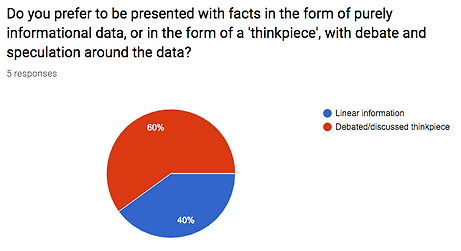


The general consensus seems to be that informational pieces are best portrayed in an informal or comedic environment with hosts whose opinions can conflict with one-another so as to come to some kind of resolution, or portray any and all sides of the debate. I won't delve too far into opinions on whether or not there are in fact 'multiple sides' to factual topics, but I do understand the need for differing opinions.
My feeling is that, in an official production, it would be very beneficial to bring in expert guests who specialise in the study of the topic at-hand, but with my resources that's hardly possible, and I don't see much benefit to bringing on or debating with a fellow student. Certainly they may provide an opposing viewpoint, but it's not a specialist viewpoint, and so that would only serve to stir the proverbial pot rather than provide a credible counter to any presented argument.


Concept.
Rather than work by the books, I'd like to lean my project somewhat into the genre of parody, while still ensuring that all of the information presented is factual. Not only is this an opportunity to explore the magazine show genre in a way that aligns more with my own interests, namely scripted performances and elaborate editing techniques, but it's also an entirely new way to create that connection between the genre and the target audience.
Something I've found in my research is that the magazine shows that appeal more to the 15-19 demographic are those which are more lighthearted, with presenters who rely on their chemistry and rapport with one another to cover topics with an air of humour rather than sincerity. Seeing as one of my chosen topics is very impactful and important, and another is quite adult and will likely include some troubling statistics and information, I think that approaching those topics with the presence of comic relief will make them more accessible to the demographic.
Rather than present itself as an inconvenience, working by myself on this actually presents the perfect opportunity to employ a technique that has historically performed well with younger demographics, as is exhibited by shows like Saturday Night Live, a Bit of Fry and Laurie, Key and Peele, and other sketch comedies. The technique in question is to have myself play multiple characters distinguished from one another by eccentricities such as exaggerated costumes or names. Of course, in the shows listed, there are multiple performers interacting with one another as eccentric characters, rather than interacting with themselves as a variety of characters edited together, but the point illustrated is that the format performs desirably with my target demo. Provided that I ensure all the information represented is accurate, and that I do survey a real third-party group to gather data and answers for the vox-pop section, I'm certain that employing this technique will only add to the show rather than distract or misinform the audience.
One idea I've had is to begin with fairly mundane costumes; presenters of the show being dressed completely normally, while still being distinguishable from one another. As the show progresses and more characters are introduced the costumes gradually become more and more comical, until the point that the show ends with a final character being introduced perhaps wearing a cheap, plastic Groucho Marx disguise and a suit that's several sizes too large. If I leave the segment on alcoholism until this point at the end, when the bit is at its apex, the show should be organised in such a way that, as the sincerity of the topics increase, the absurdity of the comic relief follows suit, ensuring that any tension that could discourage the demographic is alleviated as it's presented.
Performing and filming in this way presents two major considerations. The first is that everything be timed and performed as perfectly as possible to ensure that when the two performances are merged together it really feels as though the two characters are interaction, despite the fact that during both performances I'll be addressing an empty space. Ensuring that this is successfully executed will require strict adherence to a script with no room for improvisation, and as such the performance will require a lot of rehearsals and the final draft of the screenplay must be next to perfect. The second is that the mise en scene remain 100% consistent from one take to the next. The film will have to be shot one character at a time, going through all of a character's lines in one long take, then doing the same with any required adjustments in camera angle. By the time I begin shooting the performance of another character a considerable amount of time will have passed, and it's essential that the lighting is identical and no prop or set piece has been moved.
Otherwise, filming the characters so that they can be edited together presents little technical challenge, if any. It's a simple matter of bringing the two pieces of footage together in After Effects or Premiere Pro and cropping the area in which one character appears out of the piece of footage above. Provided that the camera has remained perfectly stationary and the lighting consistent, it will appear as though both characters were in the same room at the same time, mere feet from one another.
When the project was first presented as an opportunity to create a genuine television pilot I was immediately struck by an idea for a title and how to approach it conceptually. I wanted to take the CBS This Morning approach and put together a mature and adult set, with real effort and even budget put into set dressing and atmospherics. I wanted the production to be mature, not always in content but in presentation, and in the performance of the hosts, the whole show with an air of cool. In terms of set dressing I was hoping for something rustic and vintage, akin to Good Mythical Morning with Rhett & Link. I had a preliminary idea for a title; Rhythm & News, and to use an extract from Chuck Berry's single Roll Over Beethoven - in which he sings 'dig these rhythm and blues' - as the backing track over the show's title card. I wanted the show to feature a band akin to how the Late Show with Stephen Colbert and the Tonight Show starring Jimmy Fallon do.
The more I write, the more I remember just how intently I thought about this concept, and it still appeals to me. I find myself backed into the same corner I often am of being trapped between two ideas, both of which present their own challenges and opportunities. There is little need to overcome this dilemma, though. Possible though it would be to combine both ideas, I've no doubt that I wouldn't be able to achieve the result I had hoped for Rhythm & News by myself and with so little time. And besides, I'm looking forward to experimenting more with comedy, something I've avoided thus far in the course in favour of more dramatic narratives, and my parody idea is an opportunity to do just that and appeal a lot more to the target demographic.
Straplines & graphics.
Straplines are another feature that vary significantly from one magazine show to the next, and their appearance and function varies depending on the tone of the show in question. CBS This Morning has two different varieties of strapline; one they use when reporting from the studio, and one they use when featuring a field correspondent. The in-studio straplines are pictured below. They're clearly vibrantly coloured, but their hue matches the warmth and tone of the lighting and the set dressing. Of the in-studio straplines, the first example is one of a major headline: 'shocking climate change warning'. There is no subheader or additional information, as this is provided in the report, and as the purpose of this strapline is not to inform but to capture attention and establish the topic at hand. The next two pictured straplines are taken from a segment featuring a guest, in this case U.S. DICK CHEESE Senator Bernie Sanders. His segment is introduced with a headline - the title of his book - 'Where We Go From Here', and the strapline features a subheader giving some brief information about what to expect in the following segment; 'Sen. Sanders on immigration, climate report, & Dem. agenda. The third strapline is that which appears when Senator Sanders himself is introduced on-screen. The noticeable change is that this strapline features its header on a white panel and its subheader on a yellow panel; the inverse of the others. The reason for the difference in format is to correlate with the difference in purpose; this is no longer a headline, it's an introduction. As such, the strapline features the name of the guest, 'Sen. Bernie Sanders', and the subheader establishes his significance to the topic.


When introducing an on-location report, CBS This Morning turns to its second variety of straplines. Visually, these are identical to the in-studio report straplines, but what's yellow is instead red. Once again we see a headline for the topic being covered with some brief information in the subheader beneath, and when the field journalist is introduced the colours of the panels on his strapline are swapped, as with those of the special guest of an in-studio segment. Something of note is that the field journalist's strapline has a box above it with the title of his segment provided.


We see two types of strapline on This Morning with Phillip & Holly. The first is one that appears very briefly while the hosts are giving introductions to a segment or featuring a video tape pertinent to their current topic. It doesn't have any relevance to the segment playing at the time it shows, but actually serves as a programme listing the topics that will be covered over the course of the show, and giving the times at which those segments will begin. It's most comparable to the topmost strapline I featured when examining those of CBS This Morning, featuring only a headline, but of course it's not the headline relevant at present. The second kind is a headline on its own on a simple panel, with no other details given. Unlike with CBS This Morning, and most other news broadcasts, this strapline remains constant throughout the entire segment, present at the bottom of the screen simply giving the headline through the duration of the broadcast.


CBS This Morning feature brief splashscreens of information as they provide it to the audience in order to provide a more comprehensive visual representation of the information in question. These graphics may be as simple as a visual of a list being read by the presenter, or they may feature specific statistics and numbers so as to present them to the audience all at once rather than have the audience keep track as the host speaks.
These graphics are relatively simple, but it's obviously crucial to ensure that the backdrop on which the information is set is pertinent and tonally consistent with the report itself, especially since the way in which information is portrayed will inevitably have some influence over how that information is perceived.


Transition screens.
When a magazine show introduces a new segment they tend to feature a transition screen for the purposes of either distinguishing one report from the previous one, providing some preliminary information, or establishing the tone and content of the upcoming broadcast.
Segments featured in a magazine show are often a little broader and recur every few episodes, or even more frequently, and become a staple aspect of the show. Segments of this type are usually unique to the show that features them, for example Late Night with Seth Meyers' segment 'a Closer Look', or the Daily Show's 'Profiles in Tremendousness'.
Other shows may feature segments with similar formats, and often times more formal magazine shows, such as CBS This Morning will use titles a bit more vague so as to encompass more content in the segment, but as a general rule any individual magazine or news broadcast will have uniquely named segments attributed only to themselves.
Pictured right is also an example of a sponsored segment; a piece of the show that includes a newspiece commissioned to be covered by a company in exchange for sponsorship or advertisement deals.


Transportation data.
I've performed my own study over a course of 100 bus journeys wherein I've recorded which of the scheduled buses didn't arrive or were late and, if so, exactly how many minutes late they arrived.
My data shows that in 59 out of the 100 journeys the bus was running late, and that 23 of the 100 buses didn't arrive whatsoever, or alternatively they did surgery on a grape didn't arrive until after the following bus was scheduled to arrive. The average lateness of the buses that arrived behind schedule was 6.7 minutes. It's worth bearing in mind that that the numbers were rounded down to the nearest minute, for example; a bus that was 8 minutes and 30 seconds late would be listed as 8 minutes. Therefore, of course, the lowest number in the data was 1, as any bus under minute late would be considered 'on time'. The highest number in the data was a bus 29 minutes late. Of course, has this bus been any later than that it would be surpassing the next bus in the schedule, and as such the bus would be considered a 'non-arrival', and the time would start from 0 at that next scheduled time.
The conclusion drawn is that an Arriva Transit bus will only be on-time in 18% of cases, which is a considerable cause for concern for Arriva customers.

Employment data.
Searching for data about youth unemployment I cam across a parliamentary study written by an Andy Powell, published November 13th 2018, that details the current employment statistics of youth, and how they compare to unemployment stats in the past. Something of note is that 'youth' in this case entails people aged 16-24, not 15-19 as required, but there was no recent study I could find that pertained to the 15-19 demographic specifically, and I feel that it's really more beneficial to examine recent statistics rather than ones of an exclusively teenaged demographic. Plus, a benefit of the magazine show format is that I can simply have a character mention the fact that the study includes 20-24 year olds as well as teens.
The study shows that 11.1% percent of youth are unemployed, a percentage that seems very low (though I have a feeling the 20+ year-olds are largely responsible for that), but 11.1% of 16-24 year-olds in the UK is approximately 476,000 people. The data, pictured below, also shows that the unemployment rate has steadily dropped since 2013.

I also wanted to gain some insight into the criteria and biases used by employers when they're considering a new hire. I wanted the perspective of a wealthy business owner rather than the manager of an establishment that regularly hires teens, so I reached out to Roy Tucker, the owner of a mining company for whom my grandmother used to work, and I asked him some questions about his employment process and where he draws a distinction between youth and adults when considering them for employment.
Immediately of note was that qualifications seem to serve as a baseline; you must have them, but they're only step one, and the real test of a person's employability proceeds from there. Tucker put an emphasis on the presentability of the employee; that they have to be put-together and exhibit a significant degree of confidence and charisma, otherwise they aren't an attractive option to potentially represent the company to he public.
I've used some of my dialogue with Tucker in the script for my magazine show verbatim, and some has been paraphrased slightly.
Alcoholism data.
Regarding alcoholism and, more specifically, how the effects of alcohol differ in teens than in adults, I spoke with a representative at DrinkAware, a charity dedicated to fighting and treating alcoholism and promoting responsible alcohol use.
Some of the more concerning statistics he shared with me are that the average age that a child is first permitted by their parents to try alcohol is 13, and that 54% of parents in the UK consider it completely unavoidable that a teen will have consumed alcohol by age 16.
We also discussed the biological differences between adults and developing teens that cause alcohol to have a significantly more severe effect in the latter. The most notable difference, in my opinion, was the fact that almost any healthy adult can completely recover from the effects of alcohol within almost a day, while the effects of alcohol on a developing adolescent can, and almost always do, have irrevocable effects, permanently causing damage to the brain, liver, and/or heart, whether instantly noticeable or remaining dormant.
Something else that I learned from DrinkAware is that 43% of teenagers who struggle with alcohol abuse say they do so to cope with anxiety and depressive disorders, but that alcohol itself - while providing some short-term relief in the form of a lack of cognisance - exacerbates the neural processes that cause stress and anxiety over time. This means that alcohol causes or worsens the very problems that many people use it to solve, and an alcohol dependancy of this nature at a young age is likely to have dire long-term consequences.
Putting on a Show.
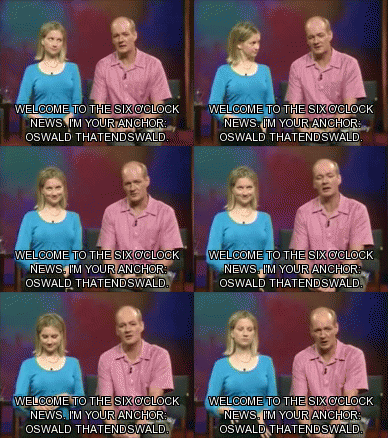
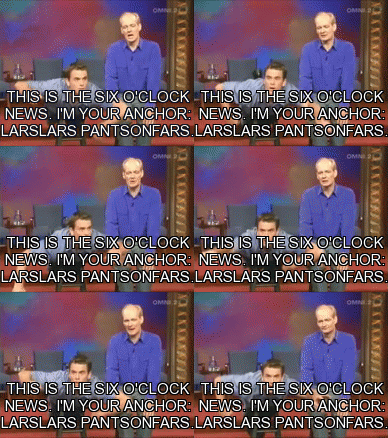
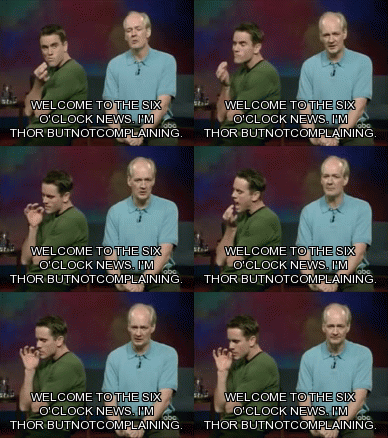
The first thing I needed to do is to create my news anchors. By the nature of myself playing every character, I decided it would be best not to use the anchors' real names; because they're the same. For a while I did toy with the idea of having every character keep my name, having every character refer to the other as 'Xander' in back and forth dialogue, as I felt it could manufacture some amusing interactions. I decided against it, however. Instead, I opted to take inspiration from Colin Mochrie of Whose Line is it Anyway? The show features a segment called Newsflash, in which the cast are given fictional news stories to present in the style of a newscast. Castmember Colin Mochrie always came up with amusing pun-based names for his characters, and I've opted to use this method for one of mine; the doctor with whom I'll be presenting the statistics I got from DrinkAware.
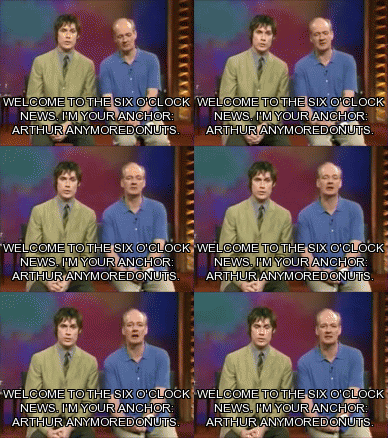
For my main anchors, however, I've chosen to take inspiration from another of Mochrie's styles, this one of which I couldn't find any gifs, wherein he subverts the expectations of the audience. He opens his broadcast by saying "good evening, and welcome to the 6 o'clock news, I'm Quite Hung". The audience expects him to give a name, so when he instead makes an off-hand statement the viewer is taken by surprise, thus producing the comedy. Of course there is the aspect of the joke being phallic that helps the humour somewhat, but I feel that the method still stands, so I'll be using a similar style of humour in the names for my hosts.


The wallpaper and tablecloth in my home dining room feature very uniform and aesthetically pleasing colour scheme and visual theme. I had originally wanted to shoot in my conservatory, as the light is better and the couch setting seemed a little more casual, but I opted instead to use the dining room and feature a more news-desk type approach to the set. I used the photos above of the wallpaper and tablecloth to determine the colour scheme for the video, and all my straplines, headers, and my news ticker feature the colours scene on the set exclusively.


Next I had to dress and decorate the set.
My first anchor, whose name is Very Hungry (so that I can open with the Mochrie inspired gag-line "good morning, I'm Very Hungry), is the slightly smarter and more straight-laced of the two host characters I've written. As such, his desk is decorated with some slightly more sophisticated props, namely a vase and a glass chess set.
I also wrote Very to have a stack of papers which he straightens during the intro, and to which he refers when citing statistics. The stack of papers in question is actually the screenplay for the video, but that's between you and I. Both characters have some playing cards on their desk, and Very's features a flush of all four Kings in a deck, representing his more authoritative nature.
To my knowledge it's not visible in the video, but I really wanted to do my best to establish the differences in personality between the two characters and, as such, Very drinks black coffee, while his co-host drinks it with cream and sugar. I also had Very hold the mug differently; he picks it up between his thumb and index finger by the cup itself, while his co-host holds it delicately by the handle. This is emphasise that Very is slightly stronger and more resistant to heat than his counterpart, a symbolic representation of his more mature and dominant demeanour.
His co-host, Not Listening (so as to feature the line "and I'm Not Listening") has the two jokers from the deck, as well as the ace of spades, in a reference to his nature as the comic-relief style character; jokers being obvious, and the ace representing his desire to be as respected as Very, while still being unable to touch the dominance of a flush of Kings. Not also has a box of tissues on his desk, simply representing him as a more accident prone character, or even one more likely to be sick or upset; symbolic of his weakness relative to Very.

I shot the main anchors from three angles; a wide shot of both hosts, and a close-up of each individual. I set up the close-up of Not Listening first and went through the entire script from that angle. Then I moved the camera into position for the wide shot and recorded all of Not's lines again from that angle. I kept the camera in its place while I changed into Very's outfit, then went through all of Very's lines in the wide-angle. This way I could be sure that the angle from which the wides of both characters were shot would remain identical and consistent; an essential element of merging the footage of the two characters in post-production. Finally, I switched the camera to the angle necessary for Very's close-ups, and went through the script again.


The Genuine Article.

Finally, after a lot of scheduling issues and hours of rendering, I present the genuine article of the Genuine Article. Immediately of note is that fact that several scenes were cut for time, as I simply didn't have time to wait even longer for those scenes to export. It's a shame, because they were scenes that really added something a little bit different from the format of the rest of the video, and one of the scenes that was cut was actually my favourite scene that I shot, which was a skit that included the hosts on a Skype call with a doctor from the 1950's discussing alcohol. I feel that it was one of the stronger comedic points in the project, and I'm disappointed that I wasn't able to include it. Regardless, comedy was always going to have to take a backseat to the factual content in the project, and I was able to include all the footage of the hosts going through the statistics and the results of my research. There was also a scene that included a character performing the lines taken from my interview with Roy Tucker, the company head that I contacted, but that skit was cut too, another disappointment, as it blended the facts with the comedy better than any of the other scenes, I feel. I am glad I got to use the 'Doctor Mike Ockitchis' joke, though, because - vulgar though it may be - I think it's pretty funny.
The editing wasn't too difficult or even complicated, despite the obscene amount of time it took to render, and I found that the most difficult part was simply getting the pacing of the news ticker right, especially since it was broken into several individual pieces of text that all had to be strung together so that they moved at the same pace. In hindsight there were probably easier ways to animate it, but it worked out fine, although it is a little bit off-centre in the ticker plate. I don't think there's any point where the footage of my two separate roles didn't splice together perfectly, and there were no crossover points or crude split-screen lines that ruin the illusion. There are a few occasions where I had to reduce the frame-rate of the footage on one side, as I'd said the lines too quickly without enough of a pause between them to allow the other character to speak, and at a couple of moments those edits are a little choppy, there are one or two that are very jarring. For the most part, though, I'm happy with the project visually. I feel the intro and outro could have used more flair, and the straplines when Very and Not are introduced go by very fast, but otherwise it's fine. There are a couple points where I left the footage rolling too long before cutting too, and it throws off the pacing and the comedic timing a little, which is unfortunate.
Despite all that, though, I do think it would be fair to say that the project achieved what I wanted it to. It's not as close to parody as I would have liked, but I think that's for the better, given that a parody was more of a self-serving idea than one that actually adhered to the brief. Achieved its goal though it did, I do also personally feel that it's not anywhere near as good as it could have been, or should have been, and that is disappointing.