
FINAL MAJOR PROJECT.
After whittling down my twelve initial ideas, I settled on these three on a basis of those among my favourites that are most achievable in terms of scope and mise en scene.

Strengths.
- One of the biggest benefits this option has going is that it's among my favourites.
- I have several ideas for dialogue exchanges between the bounty hunter and the preacher that I really enjoy.
- The addition of the supernatural element adds an extra bit of depth that consistently benefits the genre, but is surprisingly under-utilised.
- This plot explores both the morality and limits of a bounty hunter, religion, a witch doctor, and a mining company, which is a much broader range than the previous ideas.
A bounty hunter arrives in the shanty town of Brimstone Ridge to collect a fugitive, but finds that the populous are all oddly behaved. A preacher in a nearby church warns him of a curse upon the town, and the bounty hunter investigates. As he uncovers the truth that the town's occupants were all killed in a mining accident, he comes to discover that a witch doctor has raised the townsfolk from the dead and is puppeteering them as a means to continue mining further in the pursuit of gold.
Weaknesses.
- The 'corporation was controlling the villain for economic gain' twist isn't particularly original.
- Additionally, greed is rarely a very interesting motivation for a villain, as it's rather one-dimensional. Of course there are exceptions to every rule, and it would be defeatist to suggest that I couldn't write a compelling villain with said motivation, but the mystery-solving element of the plot will occupy most of the run-time.
- On the topic of run-time, there are a lot of different elements and scenes required by this plot to fit into a short film.
Opportunities.
- Experimentation with some more traditional and mystically aestheticised supernatural elements.
- More diverse costume exploration than the previous options, with outfits needed for a bounty hunter, possessed townsfolk, a preacher, and a witch doctor.
- I'd like to experiment with lots of different types of lighting, as there are very varied environments in this plot. I'm specifically excited about lighting and shooting the gold mine.
- I'd like to play the bounty hunter myself, a role about which I'm very enthused.
Threats.
- While explicitly showing the entire populous could largely be avoided, the potential need to include the townsfolk could require a large cast of extras, if only for one scene.
- Requires multiple large, specific sets: an entire shanty town, a church, the interior of at least one building in the town, and the depths of a gold mine.
- Digitally composing background landscapes for so many sets each with a large number of shots will be an extensive and time-consuming process.

Below is a link to the development work done on Burial Ground.

Strengths.
- The title. It's great. It's a great pun.
- This story features a twist, and - when executed properly - such a twist adds a lot of drama and a lot of payoff to a story.
- Once again, a setting that makes expositional dialogue acceptable, but this introduces a more open world in its finale, which provides even further opportunities for world-building.
- Another ensemble cast. When written well, it's always enjoyable to see the dynamics as ensembles of varied characters bounce off one-another.
A group of criminals are on a train being transferred to a new penitentiary. One of the criminals assures that his crew will target the train to rescue him, and encourages the other felons to keep themselves in his good graces if they want to accompany him. Eventually, a posse raids the train, but it's the posse of a different criminal, one whom the other frequently antagonised. The posse robs the train and sets free all of the criminals except the antagonistic one, leaving him alone with the guards.
Weaknesses.
- Despite the ending introducing a visible open-world, the story never really travels there, so this is another 'bottle' style plot.
- The criminals being transferred from one penitentiary to another implies that they will be outfitted in prison garbs, which eliminates a big aspect of the Western; the wardrobe. A slight change can be made to the premise to fix this issue: the criminals having only just been arrested, and now being on their way to trial.
Opportunities.
- This is the first of my options to have a more fast-paced scene, and the action-packed third act allows for a lot of exploration of special FX and cinematic shots.
- Expanding on that; the entirety of the film will require some exploration with green-screening and camera techniques, so as to make it appear as though shot on a moving train.
- A lot darker than the previous options, an opportunity to experiment with more sinister and heavy dialogue.
Threats.
- Requires a set that can replicate the interior of a cargo locomotive from the 1800's, which likely will be hard to come by.
- Requires an ensemble cast, which adds strength in writing, but causes difficulty when casting, especially from a college.
- The climax requires significant special effects, namely horses and their riders being superimposed into a passing landscape and running alongside a train. I know from making the Highwayman last year that it's doable, but it is a considerable undertaking.

Below is a link to the development work done on All Abhorred.
And, finally, the winning idea:

Strengths.
- I always enjoy a good ensemble cast, and the nature of this ensemble cast being fictional creations can make them more interesting and diverse than usual.
- This plot provides more of an opportunity than the others to make use of both up-beat and more dramatic scenes.
- The 'comic relief' character is very common nowadays, but less common is for them to be the main character. Focusing on the comic relief character, in the form of the pianist, as the character from whose perspective the audience views the film, isn't a widely explored concept.
A pianist in a Wild West saloon is renowned for his ability and talent in inventing new songs and stories, and people travel from far to listen to him. One day, however, he discovers that all of his stories come true, as the heroes and villains he's invented in all his wild tales turn up all at once in his saloon.
Weaknesses.
- While starting with some more unique elements, the plot eventually descends into a relatively by-the-numbers good vs evil firefight.
- This may seem pessimistic, but it's unlikely that I will have time to explore all of the characters in-depth. Some of the characters are likely to end up pretty one-dimensional.
Opportunities.
- This option gives me an opportunity to try writing a few songs.
- Many of the characters being over-the-top fictional creations by the pianist provides an opportunity to write some really eccentric and unique personalities.
- This plot is a chance to experiment more with comedy, and in two different styles. In the film's first act, the pianist's songs can be quite amusing. In the second and third acts, the blundering, fish-out-of-water nature of the pianist under attack from his fictional villains is another chance for comedy.
Threats.
- I have no training or education in composing music.
- While it could actually benefit the film to focus very closely on the pianist exclusively during the first act, the option to be a bit more cinematic and exhibit more of the saloon - which will benefit the Western setting - will require both a considerably niche set and several extras performing in the background.
- The pianist's characters need to be very unique and distinctive, which will require a lot of attention to detail in costume, and several good actors.
Below is a link to the development work done on the Pianist That Shouldn't've.


Project rationale
Over the past 12 units in the course I have mostly become more proficient and capable in utilising and applying the skills I already possessed, rather than gaining too many new abilities. A lot of this year has been a trial-and-error process of simply improving on being able to use my knowledge practically. Something I’ve discovered is that a lot of the ability I though I had was in a more knowledge-over-practice capacity, and that actually figuring out how to translate my knowledge of how something should be done into an ability to do it has been a lengthy and challenging process, and there’s definitely a visible improvement in the results of my applications of knowledge over the projects and films produced across the previous 12 units. I think I’ve almost managed to let go of my tendency to over-edit my films, though it still remains to an extent as a result of my very stylistic approach. Editing is probably the area in which I’ve improved the most, as it was the area in which I had the least practical experience. The course has definitely affirmed in my mind that I’m best suited to direction in terms of cinematography and shot composition. It was always the area whose results I found most compelling and rewarding.
Project Concept
Since the beginning of the second year of the course I’ve been dead-set on, at some point, producing a Western film. I’m not entirely sure why. I think something I discovered over the course of the first year is that I enjoy producing period-style pieces more than anything else, and I think many of my stylistic choices, including the lighting style, over-dramatisation of the writing, and my choices of shot composition all really contribute to a style that would suit Westerns very well. Beyond that, I simply enjoy them, and I find them starkly different and unique to many other genres.
I asked at the beginning of the second year whether there would be any projects that would give me the opportunity to make a Western, and was given no solid answer, and over the year I came to find that there weren’t any opportunities that suited what I wanted to do, so I opted to wait for the FMP so that I could go all-out. During the development stage in Unit 12 I came up with 13 different ideas for Westerns, and having had to narrow down to a single idea I’ve gone with one I called the Pianist That Shouldn’t’ve - a play on the Little Engine That Could - about a saloon pianist in 1876 who makes up songs about fictional characters, only to find one day that his characters have come to life. The idea is to have a fun, slightly musical, action romp that still blends, by necessity, into the Western style. I want to explore the way that pride influences people’s work, and the way it influences their decisions. With the titular pianist sacrificing himself at the climax of the film to save one of his creations, I felt I could explore the protective nature of people over that of which they’re proud, and the consequences that come come from one’s own pride.
Evaluation plan
I anticipate that this project, once again, will be a test in how well I’m able to restrain myself. I’ve made a habit over the two years of the course of being over-ambitious, trying to go too grand-scale in too little time, and ending up with a mediocre result. I also have a habit of making my films overly dramatic and over-edited, and now that I’ve gained some self-awareness of that I’m hoping I’ll be able to avoid it in the future, to an extent. I don’t mind my films being dramatic, I know it’s a personal choice and sometimes a controversial one but I prefer a film with sometimes unrealistic theatrics and over-the-top characters. And, as mentioned before, I have to acknowledge that sometimes heavy editing comes as a result or attribute of my very stylistic approach, and I don’t mind it, until the point that it looks ridiculously unrealistic.
I don’t think I have any problem being analytical, but a lot of the evaluations for my previous work come down to me nitpicking easily rectifiable mistakes I made rather than considering the actual net result of the process and how it contributed to the film in question. With that being said, I know I ought to be more thorough in documenting my progress, and I aim to do so with this project. I think the best way to do that is a more linear approach, according everything in a journalistic way as I go rather than recapping large chunks of the process as I have tended to do in the past.
A New Frontier
The original concept and drafts for the Pianist That Shouldn't've revolved around a more traditional spaghetti-Western concept, and only featured a few musical numbers in the first act to both establish the titular pianist himself, and to introduce the four leads. However, upon further exploration of the concept, and as a result of a rather sudden and pervasive bout of inspiration, I've decided to effectively triple my workload by having the film be sung-through.
Through the duration of Unit 12 the most consistent issue against which I kept finding myself was that of my inability as a composer. Despite numerous efforts I have remained unable to improve at all in writing chords and melodies, but I do feel that I've discovered something of an ability, at least a competency, in writing lyrics. The combination of the aforementioned inability and ability makes the most viable course of action, in terms of both achievability and potential quality, to be featuring melodies sampled from professional musicians and applying my own lyric to those melodies and structures.
I've also made the decision to cut the 'Hector Stane' character from the film, as he does little for the plot, but adds the inconvenience of a required additional cast-member.
REVISED PLOT STRUCTURE

Mise en Scene
Through twelve ideas, four re-writes, and a completely reinvented concept one issue has remained more pervasive than any other in the pre-production process and planning out the course of action for shooting a Western. The issue in question is that of mise en scene, specifically the accessibility and application of very specific sets and props.
Scenes set outdoors in the desert will be shot on a greenscreen, as it's really the only available option for such a setting without having to go through the difficulty of taking my cast-members, props, and equipment to a beach, waiting for specific intervals where there are no people in the backgrounds of the shots, and then digitally imposing a background anyway to feature a shantytown.
Fortunately for me, as exhibited in the Unit 12 work on the Pianist That Shouldn't've, there is a pub very nearby the college that fits the aesthetic of an 1800's saloon, even if a little more wealthy than is necessarily narratively consistent.
As for the props, they aren't so easy to come by. I've gone through a lot of time, effort, and money collecting, repainting, and creating props for this film.


SHILLINGSBY'S GLASSES & POCKETWATCH
Arguably the most simple of all the props, the pianist, Mr. Shillingsby, needed to be afforded a very specific aesthetic in order to appear authentic.
McMann, Pierre, and Murphy all adhere to very well known and defined looks, and so they all roughly have the same template in terms of their necessary items of clothing. Shillingsby, however, isn't a traveller, isn't versed in weaponry, and isn't much of an outdoorsman. He's not wealthy either. The difficulty in costuming a relatively impoverished individual with a very specific design is that it requires a balance between the very specialised and genre-specific props and wardrobe necessary, and consideration for the fact that this character wouldn't have a lot of owned items and accessories.
Glasses being a more or less mandatory amenity for those who need them, and a pocketwatch being a very common symbol of the era, not as much of a novelty item as it is today, struck the perfect balance.
McMANN'S HAT, REVOLVER, & SPURS
I noticed a commonly used device in a lot of the Westerns and Western-related media that I studied, and it was that the typical male lead tends to have a personally meaningful relationship with three things: his hat, his gun, and his horse.
Seeing as McMann was specifically created to adhere to this archetype, it seemed only fitting that he exhibit, at least through his design and actions more than his words, these three relationships.
The hat pictured is not the hat originally used for McMann's costume test. The first hat I purchased, which features in images from Unit 12, was a size too large for me, but also felt a little too artificial. Its shape and sturdiness made it clear that it was moulded specifically into its form, rather than having the appearance of being worn, used, and malleable. McMann's new hat, pictured right, is a lot more in line with what I wanted. It's a bit more thin and pliable, and a lot more streamlined. In the closing of the film, after Mr. Shillingsby dies, McMann rests his hat over Shillingsby's eyes, leaving it with his body, and takes Murphy's for himself. This is the way that I've chosen to show McMann's relationship with his hat, as he leaves it behind in commemoration of Shillingsby's sacrifice.
Next, McMann's revolver. This is another example of my attempting to make McMann archetypal, as I've chosen for him one of the most commonly used and featured revolvers in Westerns. I did a lot of research into handguns manufactured in the 1800's, and I determined that this one fit the bill. McMann's pistol is a .45 calibre Colt single-action revolver, with a six-shot chamber. It was first manufactured in 1973, three years prior to the setting of the film, but much later than many Westerns are set, and they tend to feature older models. McMann's revolver features many ornate engravings, which is characteristic of the gunslinger character, another more specific archetype into which McMann fits. I had originally painted it silver, but opted instead for a coat of gold-leaf, which I feel adds more authenticity and a layer of perceived experience to McMann as a gunslinger.
While McMann's horse isn't featured, except for an idea I have for a potential backdrop for the closing credits that will feature McMann and Pierre riding into the sunset, adding a pair of riding spurs to McMann's wardrobe has the benefit of making his nature as a seasoned rider clear, as well as adding another layer of detail and authenticity to his costume.


PIERRE'S HAT, REVOLVER, PISTOL, & LASSO
I didn't want to fall into the trap of needlessly feminising even the tough female lead, as many Westerns tend to do, as I'd much rather have her equal in footing and aesthetic, or even darker, than the men, as male characters do unfortunately make up 80% of the cast.
The hat I'm using for Pierre is actually an item of Indiana Jones memorabilia from my childhood. It fits Pierre's actress well, and it's significantly darker and more battered than McMann's hat, which does help to add to their separation as a pair of characters, in terms of morality, modi operandi, and attitude. It's not a stetson, as McMann's and Murphy's are and as is characteristic of the Western, but it does maintain the aesthetic well enough, and suits the actress.
One of Pierre's defining characteristics is that she's significantly more brutal than most traditional Western heroes, and certainly has a more laissez faire attitude to human life and mortality. As such, I've given her both a primary and secondary handgun, not to mention the fact that she will gain and begin using a rifle later in the film.
Her primary handgun is an 1874 MAS Modele service revolver from her home country of France. The implication is that she has a history in the French military, and that this is from where she gained her proficiency in combat and firearms. It's a more sizeable and blocky revolver than is usually common in Westerns, but this is a common difference I found in my research between American and European weapons. American weapons have a certain emphasis on aesthetics and being very minimal and streamlined, while service weapons from the French, English, and German military all tended to have a very uniform and mass-manufactured appearance.
Pierre's second gun is a Johnson Model 1836 flintlock pistol, a less official and militarised model of firearm, making it more characteristically a gun used by outlaws, criminals, and pirates in historical media and period pieces. It's a single-round gun, that takes a significant time to reload, as it has to be primed between each shot. This makes it less than useful in combat, especially across a long range, so it's featured simply as an off-hand weapon to show that Pierre has a lot of ability and interest in firearms, and to display her more combative nature.
Despite not being used in the film by Pierre whatsoever, she's described in the lyrics of Shillingsby's song as mostly using the lasso to catch and kill criminals. It makes sense narratively for her not to use it, as she ends up fighting Murphy indoor in close-quarters, an environment of which a lasso is of little use, but it still felt necessary to feature the lasso as a significant part of her wardrobe.
MURPHY'S HAT, PISTOLS, EYE-PATCH, & BANDOLIER
Murphy needed to have a significantly more worn-and-beaten look than McMann or Pierre do. I found a terrific hat, black - as is characteristic of the villain in a Western - and with an appearance of having been made with less skilled craftsmanship, and with a lot of jagged details and edges. This is to make the hat an important part of the wardrobe in terms of defining Murphy's personality and character, as it needs to represent him and his jagged morals symbolically, as there's a scene at the closing of the film wherein McMann dons Murphy's hat, leaving his own behind, which represents McMann taking on Murphy's sins as his punishment for his negligence in the battles in the canyon and the saloon, which cost so many lives as a result of a petty feud for which McMann holds himself responsible.
Murphy's guns are historically inaccurate, as the only twin pair of pistols I had were a pair of very modern-looking military handguns. Pistols weren't produced in this style back in the 1800's, so the closest aesthetic match I could find from the time period was the Remington-Beals 1st Model Percussion-Cap Revolver, a 5-round handgun.
An important aspect of the final shootout is Murphy's firearm superiority to the others, though with the association to this particular revolver he actually ends up outgunned by Pierre alone. The rifle Pierre will use is a 12-round rifle, and seeing as Murphy's guns each hold 5 rounds, she outguns him by two shots. It's a minor detail, but it will mean I have to carefully coordinate when each character fires and reloads to ensure that Murphy has dominance over the other characters in the standoff.
Important not only to Murphy's character but also to his feud with McMann is the loss of his eye. It's explained both in the song Two Heroes and the song Fire! that McMann impaled Murphy's eye with an arrow as a way to end their conflict without killing him. In the end, it only drove Murphy to be more vengeful and vicious, now leaving McMann's compassion and reluctance to kill responsible for the loss of the lives of Murphy's many subsequent victims. I had originally written a small sequence in which Murphy removes his eye-patch, exhibiting his grotesque injury, but the VFX test didn't prove as graphic or as realistic as I'd hoped, and with the new fast-paced format of the musical number in which the scene would have occurred it did little but detract from the pacing, so I've opted to simply have Murphy keep the eye-patch on for the duration of the film.
Murphy wearing a poncho created a lot of empty, repetitive space on his costume, which called for something of a little more detail to be added. Given the importance of Murphy having weapon superiority in the final standoff, I felt that having him wear a large, threatening bandolier was the right call. I found a bandolier made up of .50 calibre bullets, which don't actually fit the guns Murphy uses, but are very intimidating. The bandolier was cheap, and all the bullets were uniform colour with their casings, so I painted the bullet tips copper .


JENKINS' RIFLE
On display in the saloon is the gun that Pierre opts to use for the climactic shootout. I knew I wanted something different visually to add some extra intrigue and some additional stakes in the shootout and standoff, as originally everyone simply had a revolver to the other. I found a replica of an 1873 Winchester Carbine Repeater in a toy store, and repainted it to look more like metal and wood. Unsurprisingly it's smaller than is realistic, but I think it will look fine, and the Winchester rifle did have a short-nose option, which had a 20" barrel and held only 12 rounds. I also purchases some faux leather and sewed together a strap for it so that Pierre can wear it over her shoulder, and to give it a little bit of extra detail.
I want the aftermath of the shootout to be significant, and to have the environment be changed by the commotion. I cut the tips off of some of the fake bullets that came with Murphy's bandolier so that I was left with only the shell casings, and I painted them with gold leaf so that they would have a realistic metallic shine. This way I can have casings left behind for every time Pierre fires the rifle, and I'd even like to include a macro shot of some casing falling to the ground as Pierre unloads several rounds on Murphy.
The Song and Dance
Below are the final drafts of the screenplay and songbook for the Pianist That Shouldn't've.
THE PIANIST THAT SHOULDN'T'VE
Screenplay
Version 4.2. Includes credits & cues for backing tracks.
THE PIANIST THAT SHOULDN'T'VE
Songbook
Below are the release forms signed by Dominic Cornford (Black-Eyed Murphy), Matt Dixon (Mr. Jenkins), and Sena Akdogan (Chelsea Pierre). Liam Richardson, who plays the lead character, the titular Pianist, wasn't present at the time that I handed out the release forms, so his will have to be collected later.
Release forms are important because they give me legal access to feature and distribute the actors' likenesses, and are also clarified as 'irrevocable', meaning that no member of the cast can use the presence of their likeness as justification to prevent the film from being distributed, or garner any personal, previously unspecified gain from it.


Recording Vocals

After two weeks of rehearsals, I designated two days to spend performing and recording the vocals and dialogue for the film. First was myself, Dom (who plays Murphy), and Liam (who plays Shillingsby), recording our lines individually to be strung together in the edit.
Recording went smoothly for the most part, though some of my own vocals may need to be re-recorded, as I was ill.
I think the biggest obstacle against which I kept finding myself was the lack of real emotionality in the performances, on the part of all of us. Everyone is so concerned with the singing, the pacing, and the clarity of the lyrics that nobody was allowing themselves to be as expressive as one would be with the spoken word. It's disappointing, and it may be a threat to the quality of the film, but it's a start.
Storyboarding
I began drawing some preliminary storyboards to prepare for the first shoot. The first shoot day would be a solo shoot with no actors to get some B-roll and establishing shots of the desert and the plains of the West. A friend suggested that I shoot at Dungeness beach, which is relatively near, and suits the setting perfectly, so I'll go and get my shots there.
The storyboards worked with a little bit of wishful thinking; imagining the ideal desert rather than drawing inspiration from Dungeness. Even after shooting at Dungeness, the footage of the gila monster I included in the storyboard would need to be taken from a stock footage supply, and as such may end up being cut.


Dungeness
Before I was able to work on the storyboards any further, the first shoot day arrived. Everything went smoothly for the most part, the only significant obstacles being that I had to make sure I wouldn't disturb the local wildlife, and the fact that the concept calls for a sunrise, but I couldn't arrive on location early enough. I opted to shoot a time-lapse of the sunset which I could then reverse in post.
Below are some stills from the shoot.


For the most part I feel that the shoot went well, but I'm going to need to rework the colour grading before I include the footage in the film, because it's obvious that I increased the temperature too much and there's a distinct yellow hue that, while suiting the genre, could benefit from a little more subtlety.
It's difficult to get anything too interesting out of wide shots of deserts. As soon as the horizon is framed well there lacks any further detail to be able to focus in in terms of shot composition. Wides of sweeping landscapes look good, but they risk becoming too repetitive of bland, so it was important to utilise some landmarks and macros as best as I could. I'm happy with the result, but the stills pictured above are only a percentage of what I got, and many of the other shots are less unique of interesting.
FOR A FEW IDEAS MORE
In the process of pre-production for the Pianist That Shouldn't've, a lot of things began to jump out at me as aspects of the film that I would rather avoid, or simply wasn't fond of. In the process of developing the film I had, somewhere along the line, strayed away from the original idea. This wasn't inherently problem, as I feel that the concept of the film itself evolved in a positive direction, but I realised that not only was I moving away from the original idea, but also from all the things that I really wanted to do.
Certainly, the Pianist That Shouldn't've works better as a musical, but I didn't want a musical. Certainly it works better as a light-hearted romp with an emotional core, but I wanted something darker and more focused on consequences than intentions. I wanted to be able to cut together trailers, to experiment with obscure, gritty cinematography and lighting techniques, and to include marketable one-liners. These things don't necessarily benefit or reduce the quality of a film, but they are things that I wanted to explore and experiment with; things I find fun and challenging. And all of that was being lost in the direction I was heading.
So I'm making some heavy changes. Call it a hard reboot.
Gone are the more fanciful elements. 'Shillingsby the Pianist' is no more. I'm replacing the character with one named Ichabod Schreiber, a downtrodden newspaper editor who invents a fictional hero in an article about an outlaw in an attempt to alleviate people's fear. Gone are Guy McMann and Chelsea Pierre, the idyllic and fantastical heroes. I'm replacing their roles with a single primary antagonist, the subject of Schreiber's article; a nameless gunslinger who exists only to hunt down the outlaw. Unlike McMann and Pierre, no details about this gunslinger are known. Hopefully her obscurity even within the fictional world of the film will help to make her nature as someone driven by only a single purpose a little more pervasive to her character. It should also hopefully lend itself better to the idea of the character as a very archetypal imagining of heroism by a desperate man. Gone is 'Black-Eyed' Murphy, in favour of a less fantastical villain: the outlaw Murphy Black. No longer a one-dimensional villain archetype, Black now means something more significant. He's not just an obstacle any more. He is representative of everything that brings people to fear. Representative of the results of letting fear control and inhibit onesself. I'm also introducing a new character: Sheriff Penance. I needed a third party in the film, someone to offer a viewpoint towards Schreiber's actions from a position of authority, a sort of moral intermediary between Schreiber and Black.
Oh, and of course the final step in the overhaul - which I think has been a long time coming, I was never particularly fond of the Pianist That Shouldn't've - a new title.
HOLY WRIT
It's shorter, it's catchier, it sounds like a play on a curse word while simultaneously having a religious meaning. And all those things, including that dark self-contradiction, are perfect.
Where does the theme of pride come in now? It's a little more bleak than before. Schreiber's pride, his feeling that his intentions are above the safety of the town, compel him to write the fictitious article. And his pride gets people killed.
With the idea being revised, it also needed to be re-conceptualised visually. A darker, more reality-rooted plot meant for some necessary overhaul in the designs of the characters and the tone of the shoot. I unfortunately don't have enough time before the new version begins shooting to complete a full set of storyboards, so I've mocked up some new designs for characters and a couple of sketched of scenes and framing to serve as rudimentary storyboard-esque basing for the shoot.


Sheriff Elijah Penance concept art.
Sheriff's office framing storyboard.
Sheriff Penance prelim design.
Black-Eyed Murphy concept.
Standoff concept storyboard.
Ending shot storyboard.
Penance berating Schreiber concept.
ROOTIN' TOOTIN' READY FOR SHOOTIN'
Now that I had the new screenplay, all the updated outfits, and no time to spare, I was ready to move on to finally filming.
I decided to begin with the scene set in the Sheriff's office, featuring dialogue between Sheriff Penance and Ichabod Schreiber. I was struggling to find a location, as I desperately didn't want to shoot anything for the Western within the college, due to the apparent modernism and the debilitating lack of interesting detail or set-pieces. I was fortunate enough to be permitted to use the study in the Oakwood House Hotel, situated on the same lot as the college, which suited my needs perfectly. I will admit it's a little more wealthy than I would like the town to appear in the film, but it's a terrific set.
It might be worth noting that the manager of the set filled out the release form incorrectly, but there's little to do about that.
It's also worth addressing that the release forms signed by my actors were attributed to a production entitled the Pianist That Shouldn't've, the previous title of the project in its earlier form. This does mean that those release forms aren't binding to this new iteration of the film that I will be pursuing going forwards, so I will at some point need to collect updated release forms from my cast.


DAILY SHOOTING LOG


SHOOTING DAY 1
The walls were blank, but they had a pattern, which is the best possibility, as it enables me to dress the walls myself without worrying about disrupting any pre-existing decorations, which still making the background interesting to colour correct and frame even without set dressing.
I was able to add enough detail to the walls to keep it interesting - as well as relevant to the setting and canon - by including an American flag and a cluster of wanted posters.
More important was Sheriff Penance's desk. It's good to get a feel of a character through the visuals as well as the dialogue and characterisation, and one of the best ways to do that is through items and decorations of their own choosing, as it shows the kind of things they like to portray or utilise.
Penance's desk includes Black's wanted poster and a collection of composite sketches of other outlaws, which goes to show the importance of his job to him, as well as how driven he is. There's whiskey on his desk, which isn't a big deal necessarily - especially back then - but the inclusion of the half-empty decanter situation within reach on the desk is an indicator that perhaps Penance is a heavy drinker.
Penance also has a typewriter and a pot of pens and pencils, another indicator of his hard-working nature - and a framed family photo. A crucial trait of Sheriff Penance is that he makes decisions and takes actions usually characteristic of more apathetic characters, but Penance does so as a misguided result of his overwhelmingly empathetic nature. His care for people causes him to be impatient and callous in the face of the endangerment of the town.
The wanted posters included are two for Murphy Black, the antagonist of the film, one for 'the Highwayman', the protagonist of my short from last year of the same name, Jesse James, a real outlaw who was active at the time, and 'Butch Cassidy', another real outlaw who wasn't actually very prevalent and was quite young at the time the film is set, but who I wanted to include for the sake of the historical reference. The posters of James and Cassidy are based on their real-life wanted posters.
The shoot went about as smoothly as it could have, the only setbacks being minor time constraints and retakes due to poor camerawork. In the end the result turned out terrifically. There are a few shots in which the focus isn't as sharp as I'd like, but otherwise the shot composition and lighting were perfect and I'm ecstatic about the resulting footage. The audio, however, is where my satisfaction dwindles somewhat. Over two years of the course I have been unable to find a way to get perfect, or even just better, audio, as there's simply no affordable avenue to do so. The problem is that the room had an echo - which isn't an issue with the audio recording but rather with the lack of absorbent surfaces in the room - but also that the microphones we use in the college record a lot of room noise and tend to make dialogue a little tinny. I've done my best to clean up the audio using the Adaptive Noise Reduction and Vocal Enhancer features on Premier Pro, and it has made the dialogue clearer and cleared the room noise somewhat, but unfortunately a side effect of that is that it also reduces the bass and makes the echo much clearer.

SHOOTING DAY 2
That might be a little optimistic. Not a lot was shot. We went to move on filming the next scene; the saloon scene set in the Walnut Tree pub, but unfortunately one of my actors, Liam, who plays the writer, was ill and didn't turn up. As a result, I couldn't get the necessary scenes shot in the only window of opportunity that we had to use the saloon set. Which meant it was time for another rewrite.
With the lack of availability on the parts of all my actors on an individual day, I knew I needed to break the characters up a bit more, and certain characters who were supposed to coexist and interact would now be unable to come face to face. The best option I could think of was to switch the focal role from Liam's shoulders to my own, and bring the sheriff character into the final confrontation.
An unintentional change that came as a result of the stylistic choices I used when filming and editing the scene in the Sheriff's office is that the film now seemed a lot darker in tone. I felt that the more fantastical elements, like the fictional character coming to life and the epic gunfight were now a bit too fairy-tale and action-heavy for the new tone, and opted instead to do a complete overhaul, bringing a much darker and more bleak outlook to the entire story. In the new version, the fictional hero doesn't turn up, and Sheriff Penance ends up having to take on the role himself, which results in his death trying to defeat Murphy.
PLAN B.

HOLY WRIT
Screenplay, new final draft.
Now that I had it written, I needed to find the new sets. The first thing I needed was church, in which to shoot the new second interaction between Sheriff Penance and Ichabod. I got in contact with the church warden of St. Michael's and All Angels Church, one Jessica O'Sullivan, who was very gracious and accommodating and allowed me a few hours within which to film. The only time this could be done, however, was on the day before the deadline for the project, which subsequently meant I would have to push filming the other scenes until the day of the deadline itself, which would put me under significant time pressure to have everything edited in a single evening.
With no alternative option I could think of, I took the challenge.


SHOOTING DAY 3
The new shooting schedule and script meant that the film had to be shot out of order, which is standard procedure.
Liam and I begun at the church at midday, but costuming, and setting up the scene and camera, as well as a quick run-over of the script added up to about an hour of our time not used for even a single shot. There was also a huge setback in that we discovered after a couple of shots, while watching back the takes to make sure the focus was okay, that the camera wasn't recording audio. Ironing this out didn't take very long, but it did also mean that we had to reshoot the brief few shots we had just performed, as well as recording some foley to replace missing audio from the original takes that were visually a bit better.
Another time-consuming obstacle on the shoot was the fact that the church was situation directly beside a relatively busy road. For the most part the sound of passing vehicles wasn't audible, and even those that were would be easy to clean up, but a busy road meant that there was the occasional significantly larger vehicle or truck, and several particularly obnoxious motorbikes, and the only option there was to wait for them to pass by, which sometimes took a few minutes when the traffic was backed up.
Even despite the precautions taken to avoid the sounds of passing cars, the audio was still the biggest problem in the shoot, as there are some inconsistencies in the quality, as well as some room noise. The biggest problem is the echo. Some of the wider shots were re-recorded at a closer angle simply for the sake of getting supplementary audio, but that is likely to result in lip-synching problems, as well as some inconsistencies in quality. There might even need to be a little ADR done for some of the particularly heinous examples, which is also likely to clash with the poorer audio quality of the rest of the scene.
Fortunately, in other aspects, shoots with only a single actor are relatively smooth sailing, especially in terms of framing and performance. We went about a half hour over our time limit, which put us into a bit of a rush nearer the end, but hopefully that doesn't permeate the energy of the scene, and fortunately the church warden, Mrs. O'Sullivan, was very tolerant of it.


My newest problem is that the solution I came up with to the availability issues; making my character the central focus, had one obstacle: I had cut my hair after finishing the Sheriff's Office scene, having assumed that I wouldn't need to appear in the film again as my character didn't recur in the original version of Holy Writ. This meant that I needed to include a scene in the film wherein Sheriff Penance gets his hair cut, and to include a reason for doing so.
I opted to include hints during Penance's dialogue with his wife, Theresa, that his hair was cut short a couple decades earlier when he fought in the American Civil War, in which he and Murphy Black were on opposite sides. Penance gets his hair cut before going to face Murphy, symbolising his preparation for a war, and the fact that he is no longer being inactive in acting against Murphy.
With the new scenes: the barber's shop, the dialogue with Theresa, and the duel with Murphy, all written and planned out, I needed somewhere to shoot them that would have diverse enough set pieces for each scene and full availability on the right day. My mother's employer, Roy Tucker, owns a large manor house with a multitude of differently decorated rooms, and he also owns several large plots of land, including a large, dry field, and graciously gave me permission to film on his estate.


SHOOTING DAY 4
We first began by filming the interaction between Sheriff Penance and Theresa, as my actress for Theresa needed to leave early.
It went perfectly smoothly, we got everything done in almost no time at all, though it isn't as long as some of the other scenes. Once again, the audio turned out a bit of a problem. There is hardly any noticeable ambient sound from this set, but several lines of dialogue aren't as clear as they ought to be, and it does detract from the emotion of the scene a little. The problem with so many of the scenes turning out slightly difficult to hear or understand is that the new version of the script is so dialogue heavy, there's almost no action in it whatsoever and the entire runtime is made up of philosophical musings and debates, which makes bearable audio just about crucial, both in terms of keeping the conversations interesting to listen to, and keeping them audible at all.
There are also some shots in this scene in which the very soft lighting, the lack of detail and the colour of the walls, and the low exposure of the camera cause some quite blurry or over-dark results. It's very noticeable because it contrasts with how dynamic the lighting is in other shots, since a lot of the shots, especially the wides, focus on either of the large windows.
Ultimately the scene works, and the gorgeous score I'm using by Carlos Rafael Rivera from Netflix's Godless helps to bring the emotion to live in a way that just about salvages the poor audio of the dialogue itself.


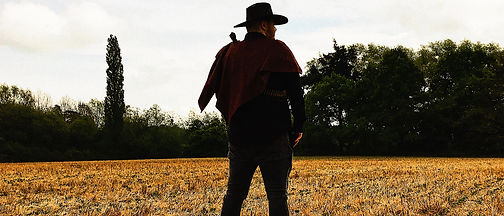
Filming the duel was a different story, and we encountered a few setbacks along the way, the first being that once we got out into the field and set up the tripod it immediately started to rain. Fortunately the weather wasn't severe enough to ruin the setting by making the field wet and muddy, and it cleared up after about fifteen minutes of waiting, but that did put us ever so slightly behind on shooting a scene that we knew was going to take a while, as every time we needed to set up a new wide or move between a different mark in the scene we would have to undergo a significant walk.
Once filming started, however, we were on a roll. it was still time consuming, and it was still a little slow, but we got everything in very few takes and the filming order and shot blocking ran like clockwork.
Really the only significant problem was that the scene I had envisioned for Penance and Murphy's deaths, in which Penance shoots Murphy with his own gun through Penance's own chest - while still doable - proved a little more difficult and restrictive than I imagined, as it was difficult to get the gun into the right position while Dominic, the actor for Murphy, held me in a headlock. I also made a rookie continuity error and forgot to remove my glasses for one shot, which means I'll have to change the angle on that and it may be a little difficult to interpret.
EDITING
One thing was for sure when watching back all the footage: England doesn't look like Arizona. In just about any way.
It's common practice nowadays, as explored in my research, to significantly alter the appearance of any Western in the edit bay, so the important thing was to figure out exactly the tone and aesthetic mine needed.
I like to cut my scene together in its entirety before working on the colour correction, VFX, music, or sound. That way I can apply a general adjustment layer to the whole scene at once, from there only having to do minor tweaks on each shot to make them consistent, and it means I have all the diegetic audio from the scene in one long audio clip, making it a lot easier to clean up and master. Well, within reason, because I'm not very good at audio editing or mastering.


I knew the colouring I wanted to match the most was that of S. Craig Zahler's Bone Tomahawk. The movie was shot digitally, and digitally shot Western's tend to have very exaggerated warm tones and greenish shadows. I tried my best to match this for the duel, and some of the other scenes were coloured slightly differently, but all mostly adhered to a few simple steps: increase the temperature significantly, lower the brightness but increase the exposure, add a lot of contrast, and then increase the vibrance and lower the saturation, all of which is done with Premier Pro's 'Lumetri Scope' function.
Throughout the whole course I've noticed that all of my work ends up being a little over-edited, especially in the brightness and contrast, and this film is no exception. In this case I think it's better to be over-dramatic and over-edited than it is to have a slightly more natural look to the film, as every little helps to make a low-budget piece shot in modern day England look like a genuine frontier setting in 1881 Arizona.


At the culmination of the duel, with Penance aware that he has no chance in beating Murphy in a gunfight, Deputy Cheswick shoots Murphy in the shoulder from long range with a Winchester rifle. Which means I need a shot with blood spatter from a bullet impact.
A relatively simple process, I began with the required shot, after having cut the scene together without the VFX of colour correction, and matched up the frame in which Dom reacts to the impact of the bullet with a sound effect of a Winchester rifle firing. I altered the audio channels of the rifle shot so that the sound mostly comes through the right speaker.
I was able to find royalty free green-screen blood spatter footage relatively easily, and I keyed out the green with ultra key. Unfortunately the special effect was quite sparse in the frame, as the blood dissipates, so a lot of the space around the edge of the effect became blurry and greyed by the Ultra Key function, and I didn't like the way the blood looked. I was able to fix both issues by colour correcting only the blood effect itself, inverting the colour channel so that the darker tones would be around the edge rather than in the middle, and then tinting it the right colour.
Finally, all that was left to do was to colour correct this shot. I used the same adjustment layer as for the rest of the duel, of course, but I needed to go back and alter the blood more to get it to look consistent with the rest of the shot once all the contrast was applied.
In hindsight I think I made a mistake in not applying a gaussian blur to the blood splatter. The camera I used isn't particularly high quality, and it's a little noticeable that the edges of the blood are slightly sharper than the rest of the image. Ultimately it's a very rapid shot and likely won't detract from anything, but it's little missed detail that show you where the film could be improved.
Holy Writ didn't require a lot of VFX or special effects. Though I usually opt for a handheld look in post production when possible, the still shots work for the slow pacing and sombre tone of the film. Mostly the only corrections and editing needed was the colour grading. I toyed around with adding some lens flares, but they felt out of place, almost too modern looking in the very period-style settings and lighting.
So, with that, the film was done.
HOLY WRIT.
Unfortunately the file is too large for Vimeo, DailyMotion, or Wix, and I can't put it on Youtube without it being blocked due to the copyrighted music. Something I should consider is that, while copyrighted music is obviously more consistent of a significantly higher quality than royalty free music, it would be wiser to go the stock-music route. However that would be a lot of time and effort spent re-mixing and mastering, and then even more spent rendering the entire thing all over again.
I've realised that, instead, what I can do is imply include a link here to the OneDrive file. This also comes with the benefit of providing the film in the best quality, as the OneDrive version is the raw file, not having been run through any internet compression or streaming quality. Click the image below to be taken to the file.

EVALUATION

The British Board of Film Classification (BBFC) attributes a rating of age-propriety to films in order to make them identifiable to their appropriate age demographic, and less accessible to age groups for whom they may be inappropriate or upsetting.
Applying an age rating to Holy Writ wasn't as easy as I expected it to be, as the criteria for different ratings within the BBFC tend to focus a lot on objective criteria and inclusions, but I feel from assessing the ratings of some movies that some things that are considered to be mature or adult themes may be identified in a more subjective manner by qualified peoples within the organisation.
Holy Writ doesn't feature any nudity or particularly strong language, but it does open with the curse-word "horseshit", which immediately disqualifies it as Uc or U. In more recent years the word "shit" has made its way into the occasional PG-rated film, but I'm fairly certain that the nature of the expletive's use in Holy Writ - berating a character with considerable hostility - moves the film into 12A territory.
There is also some brief gun violence, including to direct deaths by gunshot, each featuring a considerable amount of blood. Again, the distinction between 12 and 12A tends to come across as slightly subjective, but one character taking a gunshot to the face and then another bleeding out in a drawn-out, bloody death scene looks to move the film into a 12 rating.
To meet the criteria of a 15 films generally need to feature a considerable amount of strong language and bloody violence, or full-frontal nudity, none of which is featured in Holy Writ. I can comfortable say that I feel Holy Writ would meet a 12 or 12A classification under the BBFC guidelines, most likely the former.
The first thing that bothers me is that I didn't get to include very much of the footage I got from Dungeness in the film. There were lots of really terrific shots that just didn't make it because adding too many would detract from the pacing. The shots I did use were only included as brief establishing shots before the plot begins, and though it would be easy to include more this way, it would also expand the runtime and slow the introduction of the film with nothing contributing to the narrative.
From there, I feel that the film starts a bit too abruptly (another reason that I feel as if more establishing shots would be very jarring compared with the plot). There was meant to be a scene before the Sheriff's office that would establish Murphy and would give a little more detail about Schreiber's newspaper article, but I never got to film it because I didn't have a good set or enough actors. So the film jumps right in to Sheriff Penance berating Schreiber for writing the article, and article which the audience, at this point, knows nothing about. The scene does a decent enough job of explaining it to the viewer, but it's still a little bit of an information overload to come out of the first 30 seconds of the film, especially given that most of it is through dialogue exposition, which unfortunately is a little more 'tell' than 'show', which is the opposite of how information is best relayed in film.
The entire film is mostly dialogue, so a lot of the time I had to rely on making my shots as good-looking as possible to keep the film visually interesting, though I doubt it would even be particularly compelling to anyone who isn't interested in cinematography and lighting. My ability to use creative and artistic cinematography was somewhat hindered through the whole production by the limits of the technology I was saddled with, pun intended, but I do feel that a lot of the creative and skilled use of lighting, exposure, and shot composition shines through.
There are unfortunately some noticeable inconsistencies in the colour grading used in this scene, with the lighting changing its tone and the background varying in hue a little. It's not really noticeable as the film plays, but it's a mistake made in the edit bay, and given that I kept adjusting the exposure and the white balance while I was filming to try and get the lighting perfect and give every shot the right amount of darkness and exposure, it's a mistake I should be looking out for, because it's a failure to rectify a decision that I made during filming that I knew would create some differences in the outcomes of the shots.
Regardless, the scene plays out relatively well, I think it's one of the stronger scenes in the film, which is a problem considering it's the first one and there are only five. A lot of the credit, I suppose, ought to go to that window. The lighting it gave me, and the options for shot composition, really were stellar, and obviously nothing is more helpful in the edit bay than a raw shot that already looks great.
I do feel, however, that this scene is plagued by a problem that is present in every scene of the film, really, which is the pacing. Given the limited time and the fact that it was written in one evening, every scene feels a bit like a mad dash to give out as much expositionary dialogue and as many 'cool' lines as possible. It doesn't necessarily detract from the plot, but the problem is that it's an admittedly lazy way of moving the plot forward. The problem ultimately comes down to my character, Sheriff Penance, spending the entire film being mostly right about everything, lecturing everyone, and deciding when the plot needs to advance and where. It's a lazy, rookie writing error, and I'd give myself a pass given that it was written in one night, but it's so overt and pervasive that it's not very forgivable.
There's little to say about the barber shop scene. The set was very dark, so the entire scene is a little fuzzy and under-contrasted. It's not great, but it serves its narrative purpose as filler and to establish Deputy Cheswick. It's also very fast, which doesn't help the inconsistent pacing of the film as a whole. Over all I think the barber's shop scene is disappointing, but there's little to be done.
The scene wherein Sheriff Penance talks to his wife, Theresa, and she implores him not to take on Murphy, suffers from the same problem as most of the rest, which is the pacing. The whole scene feels a little quick, and definitely exhibits the issue of being an exhibition factory more than anything else. It's a genuine moment between two characters, but it does feel somewhat sullied by the poor characterisation of Sheriff Penance across the film as a whole, which is to say that no matter how good of a point another character makes he always has a better one, and he goes through the whole plot just telling people what's going to happen and why, and then he turns out to be right. It's disappointingly sloppy.
Apart from a few shots wherein the lighting was a bit too soft and everything looks a little washed out, the shot composition and lighting through this scene is mostly good, although I do feel I took the colour grading in completely the wrong direction. The scene is unnecessarily dark and contrasted. I'm generally good enough at making use of lighting that even if a scene is dark the viewer can still tell exactly what's going on, and I do usually prefer the dark, contrasted tones, but in the setting of a family home during a heartfelt conversation it feels a little out of place.
There was some frankly awful camera work on my part just after the very beginning of the scene, in which the angle changes and ends up all over the place over the course of a few shots. It's very jarring, the shots aren't blocked out well, and that small excerpt is just a nightmare to understand a focus on. As states, though, the rest of the scene was blocked out just fine.
There's a shot wherein Sheriff Penance spins the chamber of his revolver. The model gun I used didn't have a spinning chamber, so I had to mask a directional blur over the chamber to make it appear as though it were in motion. The effect is very simple, and not really very noticeable, but I could tell in the edit bay that if I left the shot how it was, with the chamber staying still, that would be noticeable, so the effect definitely saved the shot.
This scene also suffers because of the audio. I have a feeling that I may have forgotten to set the Vocal Enhancer feature in Premier to pick up 'female' voices as well as 'male' - those being the two presets - and so the voice of Sena, the actress for Theresa, has been muffled a little bit. It's understandable, and the music isn't too loud or dramatic in the scene, but it's just another small mistake that limited the results of the film as a whole, and it's frustrating that I kept making them.
Obviously it's difficult to tell from my perspective, as I already have all the information, but I think that the scene did enough to make it clear that Penance and Murphy fought one-another in the Civil War. That, and the acknowledgement of the haircut, somehow ended up being the most significant impacts of this scene, when what I really wanted was to establish stakes and an emotional core through Theresa.
I love the church sequence. The audio is god awful, some of the shots are way too dark and out of focus, and a couple of lines are repeated or aren't very consistent, but boy do I love it. It's overdramatic, it's overemotional, and it's a little over the top, but it works. And there are more than a few great shots peppered in there too, including one of only two shots in the film with a moving camera. In fact, the camera may have been moving a little too much. While I love the shot, there is a noticeable wobble on it as a result of my having to use Premier's War Stabiliser function to minimise the shakiness of the handheld camera movement. It's tricky without a dolly because when I attempted the motion (a slow track in) holding only the camera, the camera was very light and so it moves around too much in my hand. So I tried to do it with the tripod attached, hanging down below, which made the camera slowly sway. Neither option was ideal, so I opted to stabilise the swaying shot.
I also got to try out a fun addition to the wardrobe; a pair of very very old sunglasses. It's always nice to see what works and what doesn't when adding little details to a character, and I find that with costume design especially it's usually the most minute intricacies that help the outfit cross the line from obviously being a costume to coming alive on-screen.
I mentioned back before the title change, when I shot the Sheriff's Office scene, that the sets I ended up with were significantly more wealthy in appearance than I would've liked, and that is a problem with this scene too, unfortunately. I won't get into the topic of money and the church, but I do still feel as though the shantytown within which I had originally envisioned the film to be set would be a lot poorer than the sets, this one especially, makes it appear. Having shot the Sheriff's Office in a hotel, Penance's house in a mansion, and now this scene in an enormous, gothic church, I have certainly veered from the roots of the idea, as the purpose was to show the lengths that people would go to to help the downtrodden, i.e. Schreiber having to do something so contrived as invent a hero just to give people hope. Obviously the plot still works, but I do feel that it loses that element, and that is disappointing. Regardless, that isn't the main theme of the film. I think that, especially in the final version, the theme became more about consequentialism, and exploring the idea of intent vs. result, and which is more relevant in determining morality, and the film has still successfully maintained that.
Boy, you know I generally toe the line between being unnecessarily self-critical and holding myself to a cinema-level standard, and being incredibly arrogant and prideful, but if I'm being honest I'm veering from criticism to pride the more I look at the stills provided. Obviously it's misleading, as I went through and only screen-grabbed the best shots in the film, but if I'm evaluating I have to admit that they're really good.
Anyway, I should mention the new tone. Looking at these screenshots, and at the film itself, one would be hard-pressed to assume that the concept originally started out as a fun action-comedy musical about storybook cowboys coming to life. The final version of the film has ended up in such a bleak, gritty place, with nearly every character spending the duration being afraid, talked down to, and pondering their morality. It's a far cry from the action-packed romp that I had wanted, and it's perhaps darker even than the darkest ideas I came up with in my original twelve concepts. I can't say that I don't love that though. I'm aware that it's a place of contention in filmmaking, but I have a lot of patience for slow, droning films that present an internal struggle of ethics as more important than an external villain. With that being said, it's worth noting that there are tonal consistencies here and there because of that, as the film - having being written from five different drafts of three different concepts - does come across as a little unsure about whether the bigger problem is Murphy, or Penance's internal struggle.
I'm not sure how I feel about the duel. I like the finale from a standpoint of storytelling, especially given the themes of consequentialism and self-responsibility, but it's a bit of a change of pace from the tone of the rest of the film, which could be seen as either a good thing or bad, and I'm not quite able to put my finger on it.
For the most part it is tonally the same as the rest of the film. Obviously the visuals are a little different given that it's the only scene that takes place outdoors, but the dialogue, behaviour, and resonance are the same. However there is a (very) brief moment of fast-paced action accompanied by rather upbeat, swelling music, that stands out from the rest of the film, and I think the reason it stands out is because it's gone as soon as it arrives. That shot - the moment in question being when Cheswick shoots Murphy - could probably have benefitted from being slower. It's just as dramatic as it should be, and as the rest of the film is, but it suffers from being presented as a triumphant moment, when really it only lasts for a couple of seconds and then the film is back to being nihilistic again.
Oh can I real quick take a moment to appreciate the shot pictured right? Love it.
Anyway, the colour grading in this scene. I mentioned before that I was going for something similar to the look of Bone Tomahawk, specifically the sequence when all the characters are riding horses after first heading out of Bright Hope. I didn't match the colour grading to that as well as I could have - which isn't a bad thing, homage and inspiration are good, but obviously originality is better - but I think that the reason I didn't match it so well is also one of the potential weaknesses of the scene, and so that's why it's disappointed that I did a bad job replicating it. The thing is, I feel as though it's too oversaturated. I do, however, find it difficult to judge, because I really like how the sky looks. It's the ground and characters that are the problem.
Unfortunately, as mentioned, it started raining just as we were about to shoot. The rain died down, but the clouds didn't, and I think this is the reason for the problem. When I envisioned the scene, I was expecting clear, or at the very least mostly blue, skies, which would then be easy to differentiate from the ground and characters when colour grading, and so I could have gotten an even better looking sky than the one in the film, while still having glossy, desaturated characters, which is the look I wanted. In the end, the sky was so grey that if I had gone with the desaturated look then every wide shot or shot filled up mostly with sky would be very black and ugly, so I'm wiling to sacrifice the sepia look I wanted for the characters in favour of the better sky and lighting.
There's a sequence that's difficult to describe. I want to say 'sloppily edited', but honestly I don't think it's that simple. We performed it a bit too slowly, and it's very fast-paced, so it doesn't really match up to the rest of the film, and it ended up being very jarring if it was too quick, but a bit underwhelming if it was too slow. In the end I don't think I cut it together as well as I could have, but I did my best to salvage it. It's the sequence in which Murphy takes Penance in a headlock. Penance then brings Murphy's gun to his chest and shoots Murphy in the throat through his own heart.
Penance's death, however, paid off, I feel. It's quite long and drawn out, which is what I wanted, but I think that suffers from being done with so few camera angles. I also feel that Matt and I both could have put a little more into the performance, but still the action is clear and it works. The fake blood looked good to, and that really adds to it, though I wish I'd just bitten the bullet and either put fake blood on the shirt, or edited in a seeping wound. I could have easily done that latter, and I'm not really sure why I didn't. It's a disappointing oversight.
The final shot of Cheswick walking away isn't quite what I wanted. I had wanted Penance's corpse to be a bit more obvious, and a lower camera angle, but we discovered that most of the trees were surrounded by stinging nettles, so we couldn't frame the shot the way I wanted. I also couldn't get very low angles, because the dry grass was taller than I expected, and because the trees behind Matt obscured him due to the contrast. I still think it works, regardless, it's just not as good-looking as I wanted it to be. Wide shots from eyeline height never look as good as low-angle wide shots, in my opinion.


Over all, my consensus is very positive. The film isn't perfect, but it is good, it does work, many of the shots are genuinely terrific, and I like it. I'm happy with it. The sound quality really lets me down, and the most disappointing thing about that is that the blame isn't entirely on me. It is partially though, and it's a lesson to do my best to ensure that I can get better audio in the future.
As for the rest of it, my lesson learned is that I need to do my best to pay more attention to the sharpness and focus, and on the lighting. It's easier to get a clear, contrasted shot by under-exposing a bright setting, than it is by over exposing a very dark, poorly lit shot. In all honestly I had mostly viewed them as interchangeable methods, but this has been a sobering lesson to the contrary. I also feel that I need to be more open to change and adaptation. Notoriously, across most, if not all, of the projects I've done with the college, I've come up with one idea and stuck to it, and then just made up some other ones to supplement the process work. But now, after having known which of my twelve ideas I wanted to use from the very start, then almost entirely abandoning it, rewriting five times, and still not getting every scene, I've ended up with a story and a style that I vastly prefer to any of my original ideas. I'm left to wonder if I would have found myself in this revelation much earlier if I hadn't been so stubborn with previous projects. I'd likely have even better work to show for it across the board. Oh well.